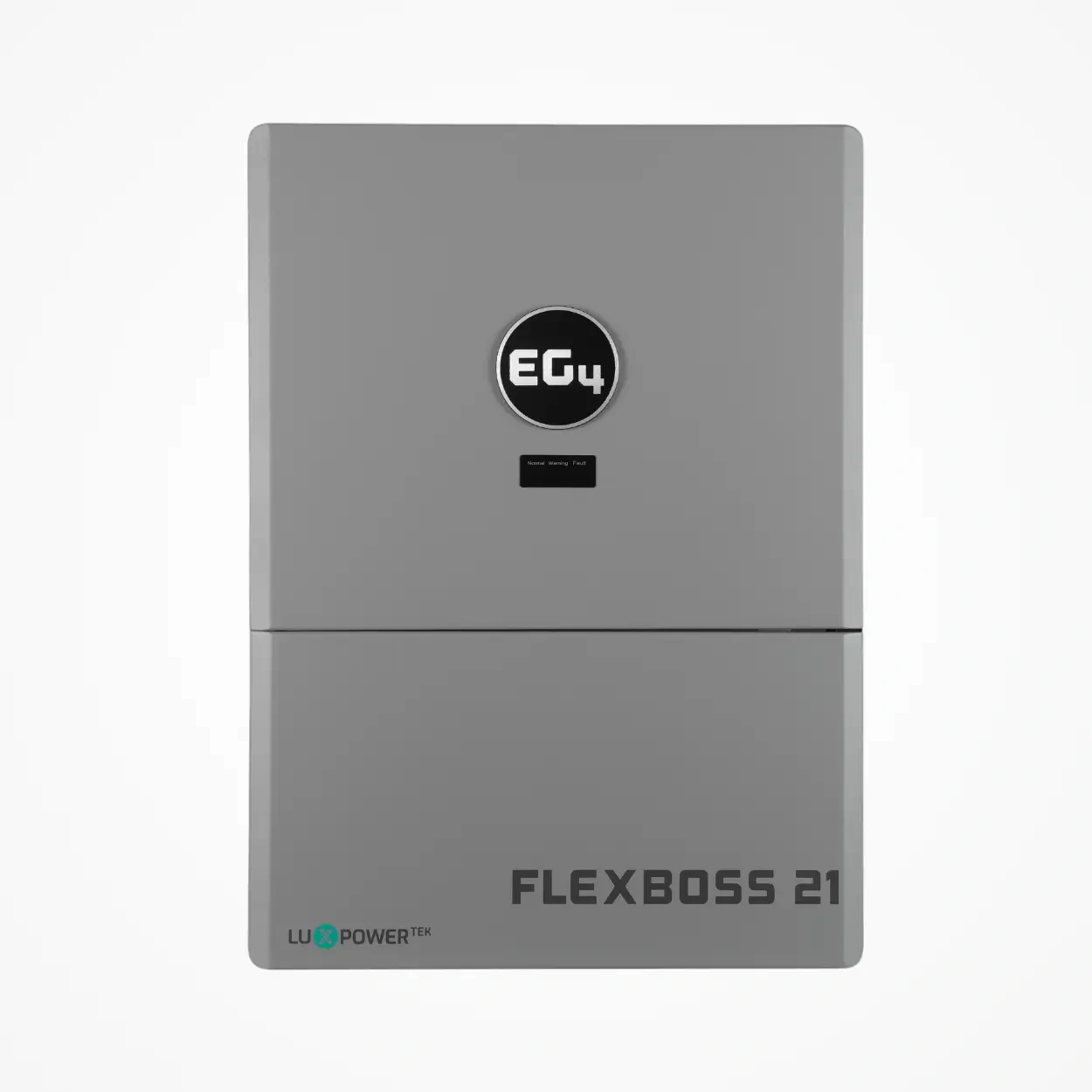
If your home may need more backup power later, I like starting the conversation with the EG4 FlexBOSS21 before we start drawing a crowded electrical room. It gives you a serious amount of power in one unit, and EG4 documents parallel operation for future expansion.
That does not mean you should buy two inverters automatically. It means we can design the first system with a clear path forward instead of treating today’s equipment as a dead end.
One FlexBOSS21 already covers a lot of ground
EG4 lists up to 16 kilowatts of continuous output when photovoltaic (PV) power is available, and up to 12 kilowatts in battery-only operation. In plain language, solar can add output while the inverter is serving loads, but an outage at night asks the battery bank and inverter to carry the full job on their own.
For a Hawaii home, that could mean supporting several normal household loads at once while still planning carefully around air conditioning, pumps, water heating, cooking equipment, or an electric vehicle charger. The 16-kilowatt figure is not a promise that every load can run together forever. The battery, wiring, service equipment, temperature, and load controls still have to support the plan.
What changes when you add a second unit
Two FlexBOSS21 inverters can provide a larger combined platform. The simple arithmetic is useful: 2 × 16 kilowatts equals 32 kilowatts of continuous output with PV support. In battery-only operation, 2 × 12 kilowatts equals 24 kilowatts before considering battery limits, temperature, settings, or other system restrictions.
That is the attractive part. The important part is understanding what else doubles or has to be redesigned. A second inverter needs its share of battery power, PV input, overcurrent protection, communications, wall space, and commissioning time. You cannot add another inverter later and assume the original battery bank and solar array will automatically be large enough.
I also want to separate inverter output from stored energy. Two inverters may increase how much power the system can deliver at one moment, but they do not double the number of hours your batteries can run the house unless the battery capacity grows too. More power and more energy are related, but they are not the same design question.
The battery bank has to grow with the output
EG4 lists a 51.2-volt nominal battery system, a 40–60-volt operating range, maximum charge and discharge currents of 250 amps, and a recommended minimum battery capacity of 600 amp-hours per inverter.
That 600 amp-hour figure is a planning recommendation from the FlexBOSS21 documentation, not a promise of a certain number of backup hours. The exact battery model, battery-management-system current capability, usable energy, and packaged energy-storage-system requirements still have to match the installation.
For lithium batteries, I prefer closed-loop communication whenever the battery and inverter combination supports it. That lets the battery management system report limits and status to the inverter. With multiple battery modules, the communication arrangement and master-battery selection must follow the battery manufacturer’s instructions. This is exactly the kind of detail that should be settled before equipment is ordered.
Solar input needs its own expansion plan
The FlexBOSS21 has three maximum power point tracking (MPPT) channels. EG4 lists normal operating-current ratings of 26 amps, 26 amps, and 15 amps. It separately lists short-circuit-current ratings of 31 amps, 31 amps, and 19 amps.
Those numbers are not interchangeable. Operating current is the current the MPPT is expected to use while the array is producing power. Short-circuit current is a separate input and protection check. Both must be compared with the actual panel data and the way the strings are arranged. The inverter also lists a 600-volt maximum PV input, a 120–440-volt operating range, and a 250–440-volt full-power MPPT range.
If we use bifacial panels, I also account for rear-side light. Bifacial arrays can operate at higher DC current than a front-only rating suggests, so the applicable bifacial current values belong in the string, conductor, protection, and inverter checks. A second inverter gives us more PV inputs, but it does not remove those individual checks.
Each PV string must be assigned to the inverter and MPPT that will receive it. The same string cannot simply be shared between parallel inverters. We also need to check cold-weather open-circuit voltage, module operating current, short-circuit current, and the number of strings on each MPPT.
Parallel operation is a commissioning project
EG4 requires parallel settings to be made in standby mode. One inverter becomes the master, the battery communication relationship must be correct, and the settings need to stay synchronized. The installer then verifies the output and adds loads in a controlled sequence.
If the system will use the EG4 GridBOSS, EG4’s manual calls for FlexBOSS21 firmware version 1E1E or newer. The parallel inverters should be configured before GridBOSS is configured. In that paired arrangement, the FlexBOSS21 load port and its CT clamps are not used in the normal way because GridBOSS handles the system-level power tracking and functions such as smart loads, generator integration, and AC coupling.
My advice is simple: if your present loads fit one FlexBOSS21 but your future plans may not, tell me that at the beginning. I can help you compare a one-inverter system with a two-inverter path, including batteries, PV, service equipment, communications, and the space required to support it properly.