When someone asks me how many Pytes V16 batteries a Big Island home needs, I don’t start by multiplying 16 kWh by the number of batteries. That number matters, but it only answers one part of the question: how much energy the bank can store.
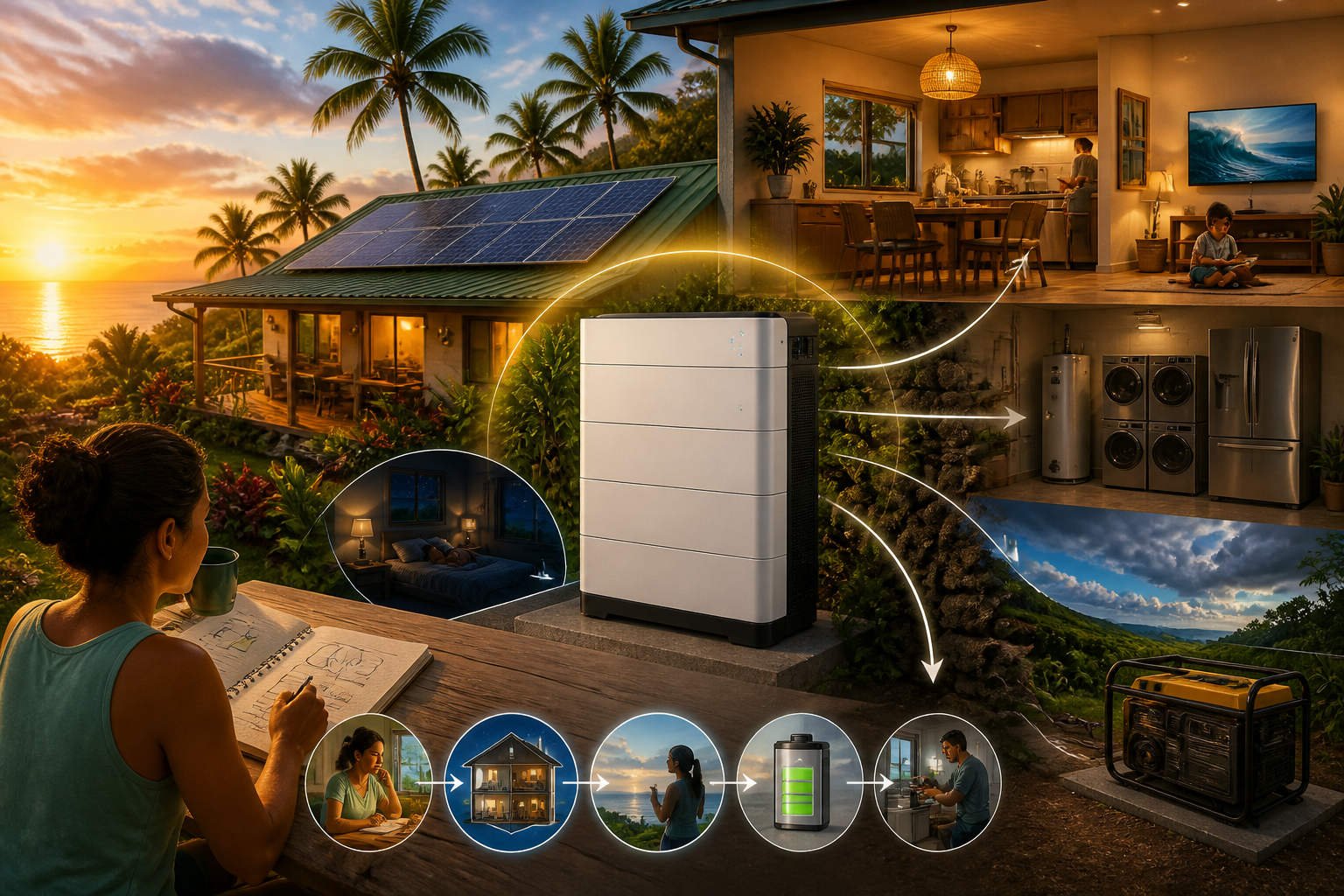
For an off-grid home, I also need to know what the battery must power at the same time, what has to start suddenly, how long the house may go without strong sun, and how the system recovers after a cloudy stretch. That is where a good battery choice becomes a good system plan.
Start with the overnight load
The Pytes V16 is a 51.2-volt lithium iron phosphate, or LFP, battery with a 16 kWh rated energy capacity. If I use an 80% planning figure and leave 20% in reserve, one battery represents about 12.8 kWh before inverter losses. That is a planning allowance, not a rule that every home should use exactly 80%.
That is useful for a first estimate. Suppose your home uses an average of 1.2 kW overnight for ten hours. The basic energy requirement is:
1.2 kW × 10 hours = 12 kWh
One V16 may look close on paper, but the inverter consumes some energy, the house may use more than average, and I still want reserve remaining before morning. A home with refrigeration, water pumps, pressure systems, communications equipment, and air conditioning can move beyond that simple example quickly.
Energy capacity and power are different jobs
A battery can have enough kWh for the night and still be a poor match for the loads. The V16 datasheet lists a recommended discharge current of 150 amps. At the battery’s nominal 51.2 volts, that is approximately 7.68 kW of battery-side power.
It also lists 200 amps as the maximum charge and discharge current, or approximately 10.24 kW at nominal voltage, plus a 300-amp peak discharge current for 15 seconds. Those figures are battery-side ratings. They do not automatically mean the connected inverter will deliver the same output to your house.
The inverter has its own continuous-output and surge ratings. The battery cables, overcurrent protection, operating temperature, state of charge, and the battery-management system, or BMS, matter too. If a well pump or compressor starts while other loads are already running, the system must handle that combined event—not just the appliance’s normal running wattage.
Surge can decide the battery count
Let’s say your ordinary household load is 4 kW, but a pump adds a short starting surge. One V16 may have enough stored energy for the evening, yet the inverter or battery bank may not have enough headroom for that starting event.
Adding a second V16 does more than double the energy to roughly 32 kWh nameplate. It also gives the bank more parallel current capability, provided the inverter, communications, busbars, protection, and battery configuration are designed for the larger bank. I never treat a second battery as an automatic cure; I use the actual load and equipment ratings to confirm the match.
Cloudy-day reserve changes the answer
On the Big Island, a system can see a very different week from one roof and microclimate to another. If your home uses 12 kWh per day and you want two days of battery reserve, the simple energy target is:
12 kWh × 2 days = 24 kWh
That does not mean a 24 kWh nameplate bank is enough. I still account for inverter losses, reserve policy, battery operating limits, and the fact that solar production may not be zero during those days. The right question is not “How many V16s equal my daily use?” It is “How much energy do I need before the next dependable recharge?”
Generator recovery is part of sizing
A generator can keep an off-grid home from running a battery bank all the way down during an extended cloudy period, but it has to be planned through a compatible inverter-charger. The generator’s available power is shared among household loads, battery charging, and the inverter’s own limits.
For example, the current V16 datasheet lists 125 amps as the recommended charge current for each battery. That does not mean I would automatically set a charger to 250 amps for two batteries. The inverter-charger, generator size, battery temperature, BMS limits, and the documented communication setup all determine the practical charge rate.
I want the generator plan to answer three customer questions: When does it start, how much load can it support while charging, and how much battery recovery can it provide before it stops? A recovery plan is much more useful than simply owning a generator.
The V16 is a strong starting point when the whole system matches
I like the Pytes V16 for larger off-grid discussions because its 16 kWh platform, 51.2-volt architecture, outdoor-rated IP66 enclosure, and scalable design give us room to plan around real household demands. But the battery count should come after the load list, not before it.
When I size one of these systems, I want to see your overnight energy use, largest continuous loads, starting surges, desired cloudy-weather reserve, inverter model, battery communication path, and generator recovery plan. Bring me those details, and I can help you decide whether one V16 fits, whether a parallel bank makes more sense, or whether the inverter and loads should be adjusted first.
The altE Store lesson on battery-bank sizing is a helpful general introduction to connecting daily energy use, depth of discharge, temperature, inverter efficiency, battery-bank voltage, and days of reserve. It won’t size your exact Pytes system, but it gives you a clear way to think about the questions we need to answer together.
Contact SolarMan when you’re ready to work through the numbers. I’ll help match the Pytes V16 bank to the way your Big Island home actually uses power.