When I compare the Pytes V5° with the V16 for an off-grid home, I don’t start with the battery name. I start with the home and the battery location. The V5° is a modular rack-style battery that lets you grow in smaller steps. The V16 is what I’d consider when a larger battery platform, outdoor placement, or fewer large modules make the system easier to plan.
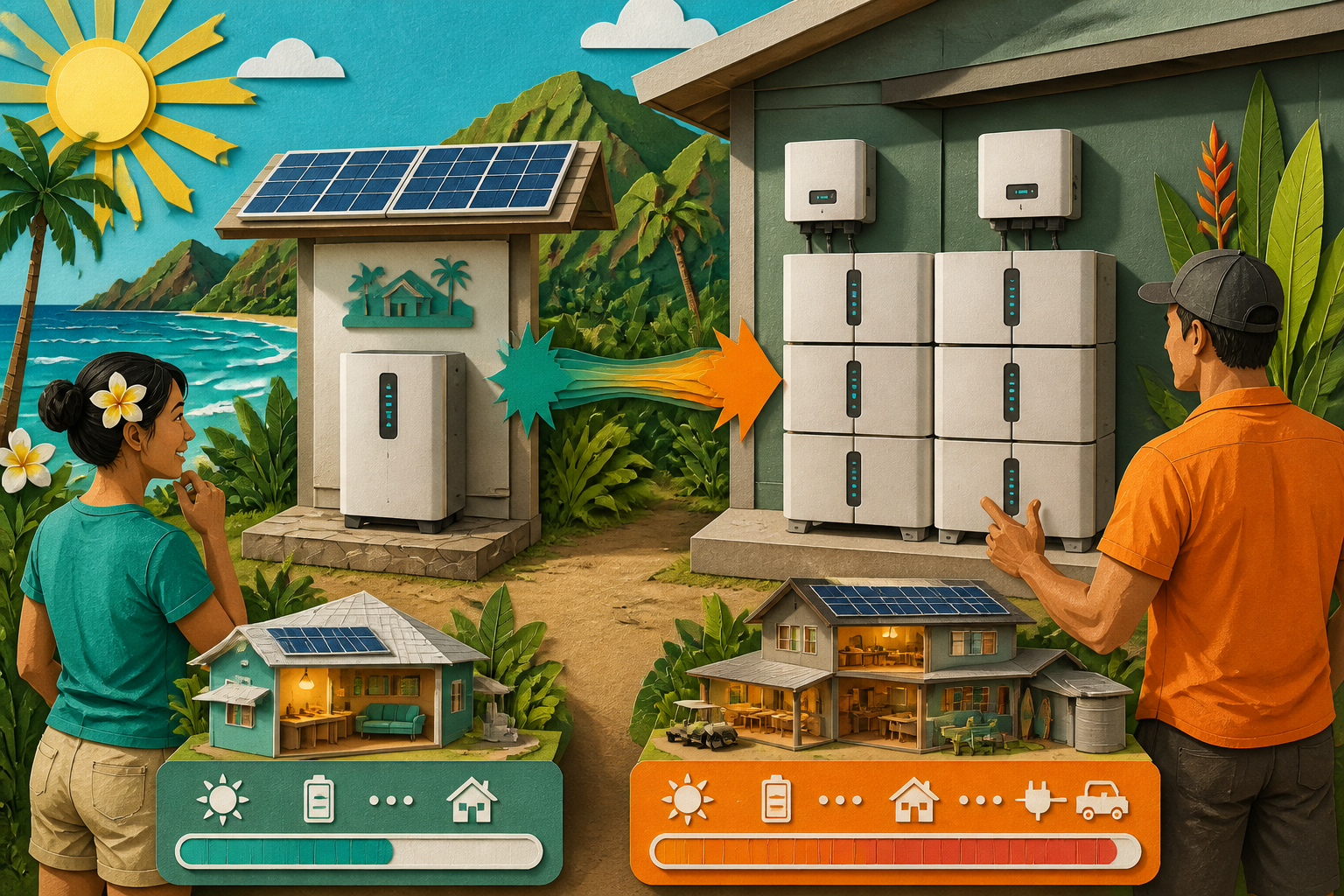
Both are 51.2-volt lithium iron phosphate, or LFP, batteries. They are in the same general low-voltage family, but they are not interchangeable just because the voltage is similar.
Start with energy, then look at power
One V5° is rated at 5.12 kilowatt-hours (kWh). The V16 is rated at 16 kWh. Three V5° batteries add up to 15.36 kWh, so that is a useful comparison: three smaller modules are close to one V16 in stored nameplate energy.
Battery-side power is a separate question. Pytes lists a 75-amp recommended charge/discharge current and a 100-amp maximum continuous charge/discharge current for the V5°. At its nominal 51.2 volts, 100 amps is about 5.12 kilowatts on the battery side.
The V16 is rated with a 150-amp recommended continuous discharge current and a 200-amp maximum continuous charge/discharge current. At 51.2 volts, 200 amps is about 10.24 kilowatts on the battery side. Those are useful comparison numbers, not a promise that any inverter will deliver the same AC output. The inverter, battery-management system, temperature, wiring, and approved settings still control the real system.
Where the V5° makes sense
I like the V5° when the customer wants a system that can grow in measured steps. One module provides 5.12 kWh, and Pytes documents up to 16 V5° units in one group, or about 81.92 kWh by calculation. Pytes also documents up to six groups with the appropriate Pytes Hub architecture.
That can fit a home with a modest starting load, an existing battery room, or an owner who wants to learn the home's actual energy use before adding more storage. The V5° platform also gives you rack, cabinet, wall, and enclosure options, so the layout can be built around the equipment space you already have.
The tradeoff is straightforward: every added module brings more physical hardware, parallel connections, communication planning, and installation coordination. That is not automatically bad. It is simply the price of having smaller expansion steps.
Where the V16 earns its space
The V16 changes the physical shape of the system. It puts 16 kWh and a 314-amp-hour battery platform into one larger enclosure. Pytes lists wall- and ground-mount options, an IP66 enclosure, C4-M corrosion resistance, integrated self-heating, and built-in aerosol fire suppression.
That outdoor-ready design is the feature I’d pay the most attention to in a Hawaii project. You are not forced to organize the whole battery plan around an indoor rack. You still need a location that meets the applicable code, clearances, access, and mounting requirements, but the V16 gives the installer another practical place to put the storage.
The V16 can also expand to as many as 16 units in parallel, or 256 kWh of rated storage, without a Pytes Hub. Each added unit is a much larger block than a V5°, so this is a different expansion strategy rather than simply a bigger version of the same rack system.
My practical choice for an off-grid home
I’d lean toward the V5° when the battery room already has rack space, the starting load is modest, or the owner values smaller capacity increases. It is a sensible way to avoid buying a large battery bank before the load picture is clear.
I’d look harder at the V16 when the home needs substantial overnight storage, the installation benefits from outdoor placement, or the project needs more battery-side power from each unit. Fewer battery boxes may simplify the physical plan, but they do not automatically guarantee lower labor, wiring, enclosure, or project cost. The site layout still decides that.
Three V5° batteries give you 15.36 kWh of nameplate energy. One V16 gives you 16 kWh. The numbers are close, but the installation is not. Three V5° units divide the bank across multiple battery-management systems and mounting positions. One V16 gives you one larger enclosure, a different current capability, and a different commissioning job.
Before choosing either one, I’d make a real loads list: refrigeration, water pumps, well or catchment equipment, cooking, communications, tools, and anything with a motor-starting surge. Then I’d confirm the inverter's battery voltage, current limits, communication profile, and approved battery settings for the exact model and revision.
A useful battery-sizing lesson
altE Store's battery-bank sizing lesson is a good companion to this comparison because it starts with the loads instead of guessing at a battery count. It explains how energy use, days of storage, battery-bank voltage, and temperature affect the storage estimate.
That is the same process I’d use with you. We can compare the V5° and V16 on paper, then match the better platform to your actual home, solar array, generator plan, inverter, and available installation space. Contact SolarMan and I’ll help you decide which Pytes approach fits the system you’re trying to build.