Hyundai HiS-T640NJ Design Check: Fewer Panels, Higher String Voltage
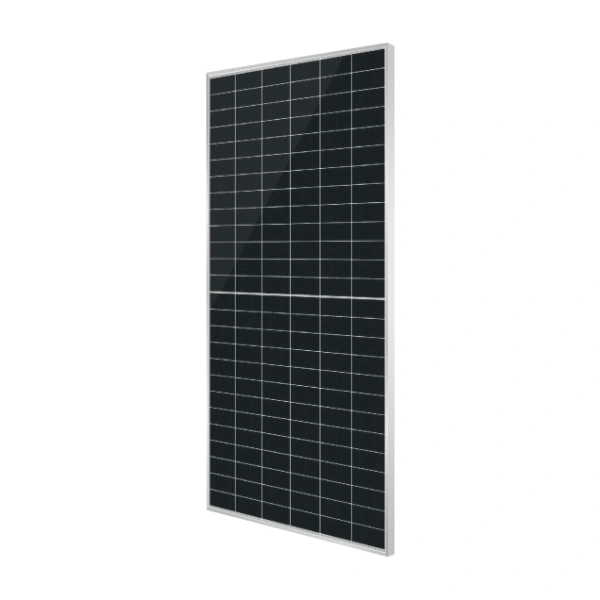
If you are building a large off-grid array, the Hyundai HiS-T640NJ 640-watt panel can give you the power you need with fewer modules. That is the main reason to consider it. Fewer panels can mean fewer mounting points, fewer module-level connections, and a simpler physical layout.
But this is a large commercial-style module. You do not size it by wattage alone. You also need to check the panel's string voltage, input current, available roof or ground-mount space, racking, and the number of people required to move and install it safely.
First, verify the panel designation
Use HiS-T640NJ on the module label and the current datasheet. Do not substitute a closely related model such as HiN-T640NJ or HiS-T645NJ just because the name looks similar.
The electrical values below come from the current bifacial NJ-series datasheet for HiS-T640NJ. If the label, distributor listing, or datasheet in front of you shows different voltage or current values, stop and verify the exact module revision before designing the string.
Why fewer panels can help
At 640 watts per module, a target array can be reached with fewer panels than with a 400- or 500-watt module.
| Target array size | HiS-T640NJ modules | Array nameplate |
|---|---|---|
| About 5 kW | 8 panels | 5.12 kW |
| About 6 kW | 10 panels | 6.40 kW |
| About 7.5 kW | 12 panels | 7.68 kW |
| About 10 kW | 16 panels | 10.24 kW |
That reduction matters on a ground mount where every post, rail section, and row adds work. It can also help when a roof has limited usable areas. The tradeoff is that each module is physically large and heavy, so the installation plan must account for access, lifting, wind exposure, and racking approval.
The electrical numbers that drive string design
Under standard test conditions, the HiS-T640NJ is listed at 640 watts with a maximum-power voltage of 47.74 volts and a maximum-power current of 13.41 amps. Its open-circuit voltage is 57.77 volts, and its short-circuit current is 14.06 amps.
Open-circuit voltage, or Voc, is the highest voltage a module can produce with no load. It is the number that matters most when checking the inverter's maximum PV voltage. Maximum-power voltage, or Vmpp, is the approximate operating voltage at the panel's rated power under the test conditions.
| Series modules | Approximate Vmpp | Approximate Voc at STC |
|---|---|---|
| 2 panels | 95.5 V | 115.5 V |
| 3 panels | 143.2 V | 173.3 V |
| 4 panels | 191.0 V | 231.1 V |
| 5 panels | 238.7 V | 288.9 V |
| 6 panels | 286.4 V | 346.6 V |
These are simple series calculations, not a complete electrical design. Actual Voc rises when the cells are colder. Before approving a string, calculate the cold-condition Voc using the applicable module temperature coefficient and compare it with the inverter's maximum PV input voltage. Never use the normal operating voltage as a substitute for the cold maximum-voltage check.
Check the inverter before choosing the string length
A 640-watt module can fit a wide range of systems, but it is not automatically compatible with every charge controller or hybrid inverter. Check four limits:
- Maximum PV voltage: The coldest calculated string Voc must remain below the inverter or charge controller limit.
- MPPT operating range: The string's hot and cold operating voltage must stay inside the equipment's tracking range.
- Maximum PV input current: Parallel strings add current. The module's Isc and Impp must be compared with the input limit.
- Maximum PV array wattage: Some equipment permits DC oversizing, while other equipment does not. Follow the applicable manual.
For two equal strings in parallel, the voltage stays near the voltage of one string while the current approximately doubles. That is why a design can pass the voltage check but fail the input-current check. The strings also need to be compatible in module count, orientation, and shading conditions.
For off-grid equipment such as a MidNite Rosie, Little Rosie, or another inverter system using a separate MPPT charge controller, the panel string is normally checked against the charge controller's PV input specifications, not just the inverter's AC rating. The correct answer depends on the complete equipment combination and firmware or revision requirements. SolarMan can match the array to the actual equipment list rather than guessing from the inverter nameplate.
Large-format panels change the layout
The verified HiS-T640NJ datasheet lists dimensions of approximately 97.0 by 44.6 inches and a weight of about 76.5 pounds. That is a substantial module. Measure the clear roof area, not just the overall roof plane, and account for setbacks, ridges, valleys, vents, fire-access requirements, walkways, and structural attachment locations.
On a ground mount, the panel length affects row spacing and the way the modules fit across the rail. On a roof, the panel width and length may force a different orientation than smaller residential modules. A layout that looks efficient on paper may become difficult if the installer cannot safely reach the top rail or carry the panel through a narrow access route.
For Hawaii projects, also think about salt air, humidity, rain exposure, corrosion-resistant hardware, and the logistics of getting large panels to a remote property. Those concerns do not make the Hyundai panel a poor choice. They mean the racking, fasteners, cable management, and delivery plan deserve the same attention as the wattage calculation.
Bifacial power is a site question
The HiS-T640NJ is a bifacial module, meaning the rear side can produce additional energy from useful reflected or diffuse light. The datasheet gives rear-side gain examples, but those examples are test conditions, not a guaranteed production number for every installation.
A raised ground mount over a bright surface may provide useful rear irradiance. A low-clearance roof mount with a dark roof usually provides much less. Avoid promising a fixed percentage gain unless the array height, surface reflectivity, row spacing, shading, and local conditions have been modeled.
For a Hawaii ground-mount project, a bifacial panel may be especially worth evaluating when the site allows clearance beneath the modules and the ground surface can contribute reflected light. The design should still be financially and electrically sound using conservative front-side expectations.
Daily energy is not the same as panel wattage
A 640-watt rating is the module's output under defined test conditions. It is not a promise that one panel will deliver 640 watts continuously or produce 6.4 kilowatt-hours every day.
Daily energy depends on sun conditions, temperature, orientation, tilt, shading, soiling, wiring losses, charge-controller behavior, battery state of charge, and inverter losses. In an off-grid system, the battery may already be full during part of the sunny period, causing the controller to reduce charging power even though sunlight is available.
Use the 640-watt rating to size the array and compare physical options. Use a site-specific production model and the actual battery and load profile to estimate daily energy.
When I would recommend this panel
I would recommend the Hyundai 640-watt panel for a buyer who has enough installation access for a large module, wants a high-power array with fewer panels, and has an inverter or MPPT controller that can accept the resulting string voltage and current.
It is a strong candidate for larger ground mounts, agricultural or workshop systems, remote Hawaii properties, and other projects where reducing module count has real value. It may be a poor fit for a small roof with difficult access, a system whose charge controller cannot accept the string voltage, or a layout that requires many differently oriented roof sections.
Send SolarMan the equipment list, target array size, roof or ground-mount dimensions, and battery voltage. SolarMan Consulting can provide a quote or match the Hyundai HiS-T640NJ to the rest of your system without mixing it with specifications from a different Hyundai panel revision.
Watch: How Solar Panels Generate Electricity
This clear lesson from The Engineering Mindset shows how photovoltaic cells turn sunlight into usable electrical power. Use the Hyundai module data and system-design guidance in this article for the exact string calculations.
Video by The Engineering Mindset. Watch on YouTube
Technical Sources
Technical information in this article was checked against the following sources.
- HD Hyundai Energy Solutions NJ Series datasheet for HiS-T640NJ (Manufacturer datasheet copy)
- California Energy Commission Solar Equipment List, HiS-T640NJ (Government equipment database)
- HD Hyundai Energy Solutions official solar module product page (Manufacturer product page)