How the MidNite Rosie 7048 Can Make Generator Backup More Practical
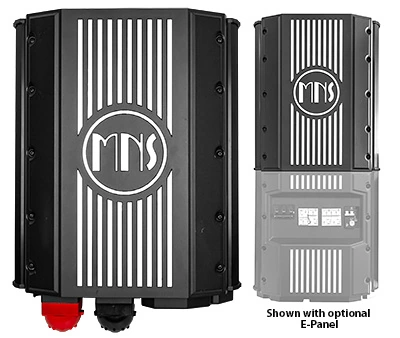
When a customer tells me, “I want the batteries to carry the house, but I also want a generator available when the weather stays rough,” I start looking at the inverter as the system’s traffic controller. That’s where the MidNite Rosie 7048 gets interesting.
The Rosie is a battery-based inverter/charger. It takes power from a 48-volt battery bank and produces 120/240-volt alternating current (AC) for the building. When a compatible generator is connected and accepted by the system settings, it can transfer that AC source to the loads and charge the batteries. You’re not buying separate boxes that each handle only one part of the job.
A useful amount of power for a 48-volt system
MidNite lists the Rosie 7048 at 7,000 watts of continuous output under its rated conditions. That gives you a serious amount of room for a home, workshop, or larger off-grid installation. It can supply ordinary 120-volt circuits and 240-volt equipment from one split-phase system, provided the loads and battery bank are designed to match.
Here’s the number I want customers to understand: 7,000 watts divided by a nominal 48 volts is about 146 amps on the battery side before accounting for inverter losses. That doesn’t mean the battery will deliver exactly 146 amps every moment, but it shows why battery capacity, cable design, overcurrent protection, and disconnects matter just as much as the inverter’s AC rating.
This is also why I don’t size a Rosie by looking only at the largest appliance. I look at the normal loads, motor starts, battery capacity, solar charging, and generator plan together.
Why the generator connection matters
The Rosie’s charger can accept generator power and charge the battery bank at up to 120 amps of battery charging current. That is valuable during several cloudy days, after heavy evening loads, or when a customer wants the generator to run for a shorter, more purposeful window.
For example, imagine a 48-volt battery bank that is low after a storm. Instead of asking the generator to power every load directly for hours, the Rosie can use the generator’s AC input while also charging the batteries. Once the generator stops, the batteries take over again. The exact generator size and charging setting still need to be matched to the battery, fuel supply, and expected loads, but the operating idea is simple: use the generator as a planned charging source, not as the only source of electricity.
The Rosie has a 60-amp transfer relay on each 120-volt leg. That gives the system a substantial AC pass-through capability, but it does not make every generator suitable. I still want to know the generator’s output, whether it produces stable 120/240-volt power, and how it behaves when the charger changes demand.
Automatic generator start can reduce daily babysitting
The Rosie includes an auto-generator-start menu and two auxiliary input/output connections. In a properly designed system, those controls can help start a compatible two-wire generator based on conditions such as battery voltage or state of charge. State of charge means the system’s estimate of how full the battery is.
I like that approach for a customer who may be away from the property or who doesn’t want to walk outside every evening to check a generator. But automatic start is not magic. The generator must support the right control method, and the battery-monitoring setup must be commissioned correctly. I treat the auto-start function as part of the system design, not as an isolated feature to switch on casually.
The RE and M versions are not interchangeable choices
MidNite documents both the MNROSIE7048RE and the MNROSIE7048M. The RE model is intended for renewable-energy systems such as homes and cabins, with common AC input and output neutrals. The M model is intended for mobile applications and uses a different neutral arrangement for automatic neutral-to-ground switching.
That distinction matters. When I quote or plan a system, I want the model suffix on the actual product label and the current manual to agree with the installation. A house, cabin, RV, marine system, and truck may need different treatment even though the front of the inverter says Rosie 7048.
Where I think the Rosie fits best
I see the Rosie 7048 as a strong fit when you want a 48-volt battery system with meaningful 120/240-volt capacity, generator charging, and a clear path to automatic backup operation. It makes particular sense when the system needs to coordinate solar charge controllers, batteries, household loads, and a generator instead of treating each one as a separate project.
MidNite’s optional Rosie E-Panel can add a cleaner enclosure for AC and DC overcurrent protection and disconnects. That can make the equipment easier to organize and service, although the E-Panel is not the inverter itself and it is not automatically required for every installation.
If you’re considering the Rosie 7048 for a Hawaii home, cabin, shop, or backup system, contact SolarMan. I can help you sort out the battery size, solar charging, generator match, model suffix, and 120/240-volt load plan before you buy equipment that doesn’t fit together.
Watch how it works
It is relevant to understanding Rosie operating modes and source coordination, but it is not a generator tutorial or a review of a SolarMan installation.
Grid Curtailment Using the Midnite Rosie Inverter — Around the Homestead with Sue & Ryan
Sources and product details
Manuals and product information behind the details above.
- MidNite Solar — MNROSIE7048RE product page (official manufacturer product page)
- MidNite Solar — MNROSIE7048 Manual, Revision C (official manufacturer manual)
- MidNite Solar — Rosie E-Panel MNE300ROSIE-240P (official manufacturer product page)
- MidNite Solar — Rosie product document index (official manufacturer document library)
- Around the Homestead with Sue & Ryan — Grid Curtailment Using the Midnite Rosie Inverter (educational YouTube video with English publisher metadata)
- MidNite Solar forum discussion referencing the Rosie grid-curtailment lesson (publisher and relevance context)