If you want to sleep comfortably in an off-grid Hawaii home, air conditioning may be the load that decides your battery size. I wouldn’t begin by asking how many batteries fit on the wall. I’d begin with a more useful question: how many kilowatt-hours does the air conditioner actually use between sunset and morning?
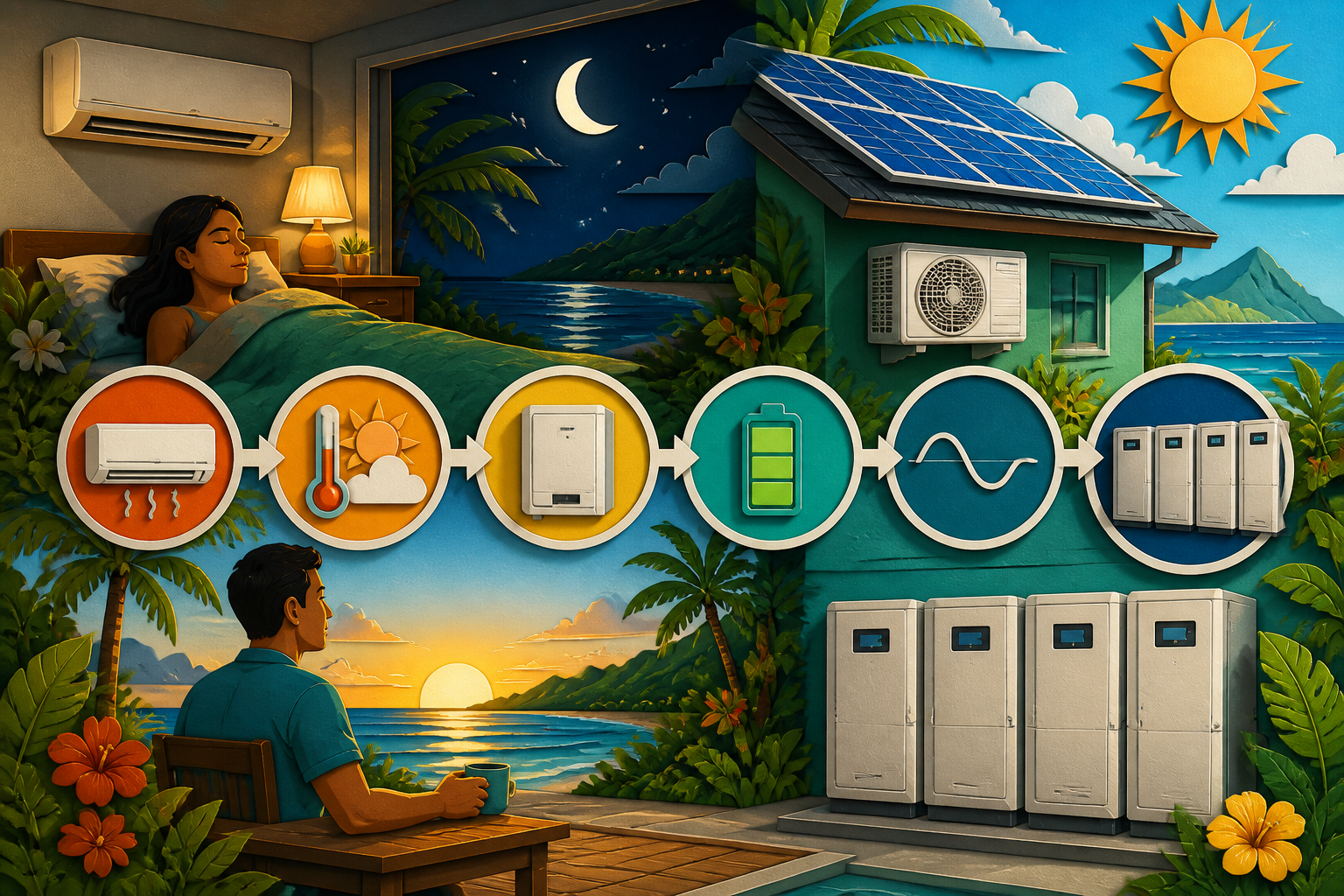
A Pytes V16 gives us a practical example. It is a 51.2-volt lithium iron phosphate battery with 16 kilowatt-hours of rated energy. Pytes lists a recommended discharge current of 150 amps. At the battery’s nominal voltage, that works out to about 7.68 kilowatts of battery-side power. That is not the inverter’s AC output or a guarantee that every air conditioner will start. The V16 still has to be matched to the actual air conditioner, inverter, and other household loads.
Start with energy, not the air conditioner’s cooling number
Air conditioners are often labeled in British thermal units per hour, or BTU/h. That describes cooling capacity. It does not tell us directly how many kilowatt-hours the unit will take from the battery.
For a planning example, suppose an efficient mini-split averages 800 watts from the alternating-current side while it is cooling overnight. Running for nine hours gives us:
0.8 kilowatts × 9 hours = 7.2 kilowatt-hours
That is an average-use example, not a promise. The compressor may draw more while the room is hot, then settle to a lower level after the thermostat is satisfied. Outdoor temperature, insulation, open doors, fan settings, humidity, and the temperature setting all change the result.
Then add the rest of the overnight home
The air conditioner usually isn’t alone. A refrigerator, internet equipment, lights, fans, water pumps, and small electronics may add another 1.5 kilowatt-hours overnight. In this example, the loads need:
7.2 kWh for cooling + 1.5 kWh for the home = 8.7 kWh of AC energy
The battery has to supply more than that because the inverter is not perfectly efficient. If we use a planning assumption of 92 percent inverter efficiency:
8.7 kWh ÷ 0.92 = about 9.5 kWh from the battery
Instead of treating all 16 kWh as available, I would use an 80 percent planning window for this example:
9.5 kWh ÷ 0.80 = about 11.8 kWh of rated battery capacity
That leaves roughly 20 percent in reserve. It’s a planning method, not a promise of exact AC energy delivered under every temperature, load, or battery condition.
What that says about one Pytes V16
Assuming the battery starts the night charged and the daytime system has restored it, one V16 has room for the overnight air conditioner, the other listed loads, inverter losses, and the reserve used in this example. That is the encouraging part. The V16’s large energy capacity means we’re not forced to treat every warm night as an emergency.
But I would not call one battery the answer for every home. If the air conditioner averages 1,200 watts instead of 800 watts, the cooling portion becomes:
1.2 kilowatts × 9 hours = 10.8 kilowatt-hours
Add the other 1.5 kWh of household use and the AC load total becomes 12.3 kWh. After allowing for 92 percent inverter efficiency, that is about 13.4 kWh from the battery. Keeping the same 20 percent reserve gives us:
13.4 kWh ÷ 0.80 = about 16.7 kWh of rated battery capacity
That is already more than one V16’s 16 kWh rating, before adding extra weather margin. A second V16, a smaller cooling zone, a higher thermostat setting, or a plan to use the generator during difficult weather may all be sensible options.
Thermostat cycling changes the answer
The nameplate maximum is useful for checking the inverter and circuit, but it is usually not the same as the energy used all night. An inverter-driven air conditioner can slow its compressor after the room reaches temperature. A fixed-speed unit may cycle on and off at higher power. Either way, the average matters.
For a real project, I want measured or documented input watts, hours of operation, and the expected indoor temperature. A plug-in energy monitor may help with a suitable small unit, while a qualified electrician can measure a permanently wired system. We should use the actual equipment data when the battery count depends on a narrow margin.
Power and energy are two different checks
The V16’s energy capacity answers, “How long can the battery support the load?” The inverter answers, “Can the system deliver the load right now?” Those are separate questions.
An air conditioner may have a starting event, and other loads may start at the same time. The inverter must handle the combined running power and any permitted surge. The V16’s battery-management system also needs either a documented closed-loop communication profile or a documented open-loop setup for the exact inverter. A 51.2-volt match by itself does not prove that the system is ready.
Morning recovery is part of overnight sizing
After a hot night, the battery needs enough solar the next day to run daytime loads and put back the energy used overnight. If the array only replaces yesterday’s consumption during perfect weather, several cloudy days can push the system toward a generator or a load reduction.
This is where I look at the whole pattern: overnight cooling, daytime air conditioning, solar production, battery reserve, and generator recovery. One V16 may be an excellent fit for a carefully managed mini-split. A larger home with multiple zones may need more storage, more solar, or a plan that cools selected rooms instead of the entire house.
altE Store’s Battery Bank Sizing: Off Grid Solar Power System Design - Step 2 is a useful general lesson because it walks through the same basic discipline: list the loads, convert them to energy, and size the battery around the real requirement. It doesn’t replace a Pytes V16 design, but it helps make the math easier to follow.
Give me the air conditioner model, the hours you want it running, the other overnight loads, and whether you expect generator support. I can help you see whether one Pytes V16 gives you comfortable margin or whether the system should be planned around a larger bank and faster morning recovery.