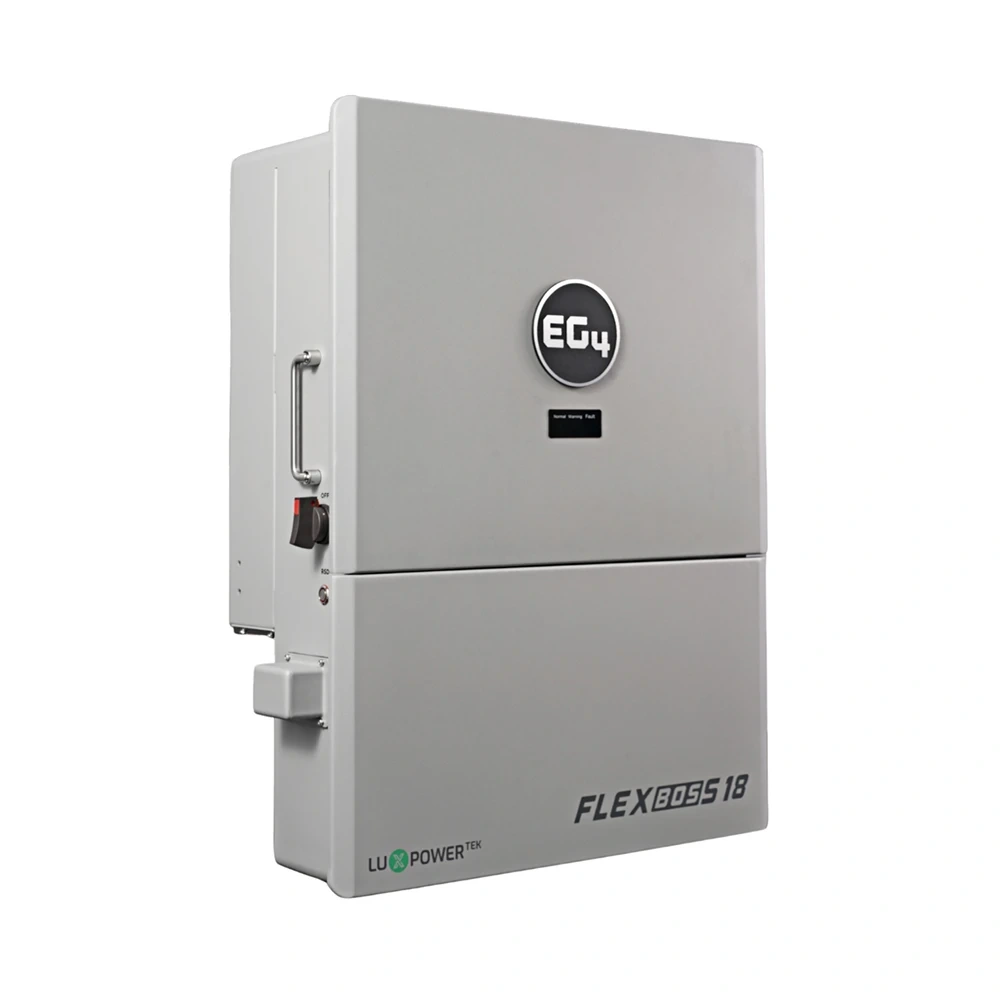
I like the EG4 FlexBOSS18 because it gives a Hawaii home a serious amount of usable power in one enclosure. EG4 rates it for up to 13 kilowatts of continuous output with photovoltaic power and grid assistance in the applicable grid-connected condition, or 10 kilowatts from the battery alone. That gives us a strong starting point for backup planning.
Those numbers still depend on the battery. The battery bank has to supply the inverter, and the inverter needs to understand what that battery is allowed to do. That is why I pay close attention to communication before I recommend a final battery count.
Closed-loop communication gives the battery a seat at the table
A compatible lithium battery can communicate with the FlexBOSS18 through its battery-management system, or BMS. The BMS is the battery’s internal control system. It watches conditions such as voltage, current, temperature, and state of charge, then shares operating information with the inverter.
In a closed-loop system, the inverter can use the battery’s permitted charge and discharge limits instead of relying only on manually entered settings. That matters when the battery is cold, nearly full, temporarily limiting current, or protecting itself from an abnormal condition.
The FlexBOSS18 lists a maximum battery charge current of 208 amps and a maximum discharge current of 208 amps. That is the inverter’s side of the conversation. The battery bank may allow less, especially if there is only one battery or if its BMS has reached a temporary limit. The lower permitted limit wins.
This is also why I do not size a FlexBOSS18 battery bank by kilowatt-hours alone. Stored energy tells us how long the battery may support a load. Battery current capability tells us how much power the bank can deliver at that moment. A large energy number does not automatically make a battery suitable for the inverter.
Compatibility comes before the communication cable
The FlexBOSS18 supports Controller Area Network (CAN) and RS-485 serial communication. That does not mean every 48-volt battery will communicate correctly. The exact battery model, revision, firmware, communication method, cable pinout, and inverter profile all matter.
For an EG4 battery bank, I want the battery documentation and current EG4 compatibility information checked before commissioning. EG4 specifically notes that LifePower4 V1 batteries may need a firmware update for closed-loop communication. Some third-party batteries may support only certain communication methods, and lead-acid batteries do not use the same closed-loop approach.
A cable that fits an RJ45-style port is not proof that the protocol is correct. The cable, pinout, battery profile, and firmware all have to agree. Catching that early can prevent the frustrating situation where the battery is physically connected but the inverter still cannot read it properly.
EG4 Connect turns setup information into something useful
EG4’s current Connect guide provides a guided commissioning workflow. It gives the installer a place to identify the system, select the battery type, choose a compatible battery model when applicable, and continue through the rest of the setup. The FlexBOSS18 manual also documents battery selection and monitoring through EG4’s monitoring system.
If the battery communicates, the inverter can use state-of-charge control. If the battery cannot communicate, EG4 documents a different voltage-based control path, with settings kept within the battery manufacturer’s limits. That distinction matters because a battery that is merely connected is not necessarily a battery the inverter understands.
After commissioning, I want to see more than a green status light. I want to know whether the FlexBOSS18 is seeing the battery, whether the reported state of charge makes sense, and whether charge and discharge behavior matches the battery documentation. Useful monitoring gives us a better starting point if you call after a cloudy week or an unexpected shutdown.
For a short primer on the communication side, Kvaser’s CAN Basics Training Introduction explains what a Controller Area Network is, how the physical bus and communication layers fit together, and how data moves between devices. It will not select a FlexBOSS18 battery profile for you, but it makes the reason for matching the communication method easier to understand.
Keep the output numbers in their proper lanes
EG4 lists up to 18 kilowatts of usable photovoltaic input for the FlexBOSS18. Solar input is not the same as battery output, and battery output is not the same as stored energy. A customer may have enough battery capacity for an overnight load but still need additional batteries if the home has a large starting surge or wants to run several major loads at once.
I also pay attention to the battery’s cutoff settings. EG4 recommends a 20 percent cutoff state of charge with EG4 batteries to maintain an 80 percent depth of discharge. That is a documented starting point for the EG4 battery relationship, not a universal setting for every battery. The exact battery instructions still control.
What I want to know before recommending the FlexBOSS18
Before I match this inverter to your home, I want the exact battery model, planned battery count, expected loads, solar-array size, and whether you want grid-connected operation, backup power, or both. Then we can check communication compatibility and decide whether the battery bank has enough current capability for the loads you care about.
That is the real advantage of the FlexBOSS18: it can be the center of a capable system, but it does not ask the battery to work blindly. Contact SolarMan and I’ll help you determine whether the FlexBOSS18, the battery bank, and the rest of your system are speaking the same electrical language.