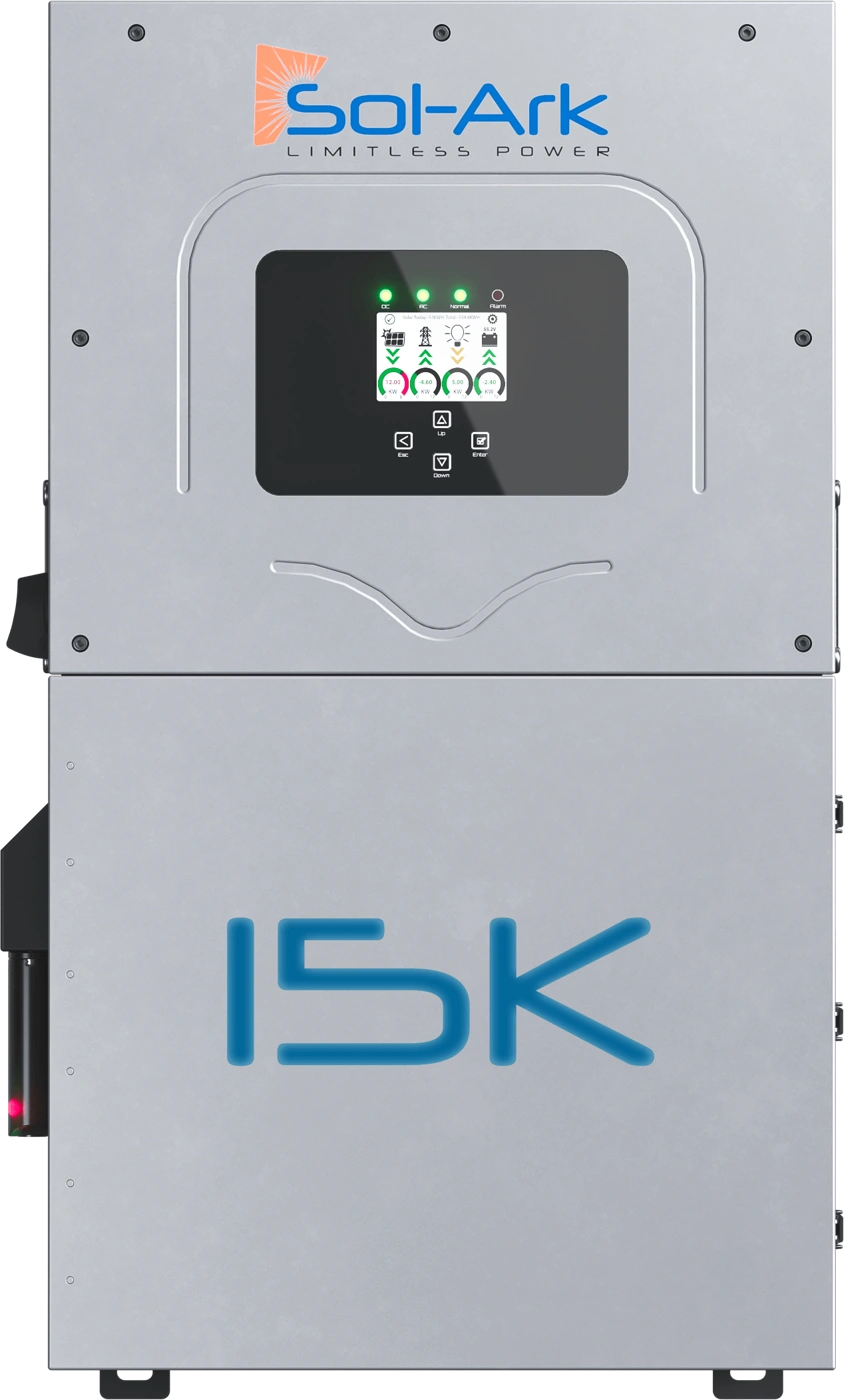
One reason I like the Sol-Ark 15K-2P-LV for a complicated Hawaii roof is that it doesn’t force every solar panel section to behave like one big identical array. The inverter has three independent maximum power point tracking inputs, or MPPTs. That gives us room to separate roof sections that face different directions, see different shade, or need different string planning.
That flexibility matters more than simply counting the number of solar panels. A south-facing roof section may have a different production pattern from an east- or west-facing section. A roof near a tree, ridge, vent, or neighboring structure may also behave differently during the day. If we put every section on the same MPPT, the inverter has to track one operating voltage for strings that do not really see the same conditions.
Think of the three MPPTs as three solar work areas
The Sol-Ark 15K-2P-LV supports three independent MPPTs, with up to two photovoltaic strings per MPPT. In plain language, that gives us six direct solar string connections, arranged as three independently tracked groups.
I wouldn’t treat that as permission to mix anything anywhere. It’s better to think of each MPPT as a work area for strings with compatible electrical behavior. If two strings are connected in parallel on the same MPPT, Sol-Ark says they should have the same designed open-circuit voltage. When panels face different directions on the same MPPT, Sol-Ark warns that photovoltaic efficiency can be reduced.
So, if a home has an east roof, a west roof, and a smaller section with afternoon shade, the planning conversation may be: which section deserves its own tracker, and which sections can safely share one? That’s a much better starting point than assuming the roof should be wired according to physical convenience alone.
The voltage numbers set the boundaries
The current Sol-Ark 15K-2P-LV datasheet lists a rated MPPT operating range of 150 to 425 volts of direct current (DC). Startup voltage is 125 volts, and the maximum photovoltaic (PV) input voltage is 500 volts. The final string count has to be calculated from the exact panel’s voltage specifications and the expected temperature range at the installation site.
The 500-volt figure is a hard maximum for the photovoltaic source circuit. A string that exceeds the inverter’s maximum open-circuit voltage can damage equipment, especially when cold-weather voltage rises. That’s why I want the designer checking cold open-circuit voltage, not just looking at the panel’s normal operating voltage on a warm afternoon.
There’s another important distinction: the 15K-2P-LV lists a maximum operating photovoltaic input current of 26 amps per MPPT and a maximum short-circuit current of 44 amps per MPPT. The inverter can self-limit operating input above 26 amps, but Sol-Ark warns that short-circuit current above 44 amps can cause damage. Those numbers are not interchangeable. Operating current helps us understand how the inverter will work with the array during production; short-circuit current is the array limit we must check under the fault-current condition.
A simple roof example
Imagine a customer has two strings on one roof plane, one string on a detached garage, and another string on a section that loses afternoon sun. We’d first compare the exact string voltage and current values. Then we could consider giving the garage and shaded section their own MPPTs if that produces a better match, while keeping compatible strings together.
This doesn’t guarantee a specific amount of energy. Shade, weather, panel temperature, roof direction, and the customer’s actual layout still control production. The benefit is that the inverter has more independent tracking capability to work with the roof we really have.
It also helps keep the design honest. If two strings are intended to share one MPPT, I want them to have matching designed voltage and a sensible current relationship. If they don’t, a separate MPPT—or a different array layout—may be the cleaner answer.
What I want checked before the equipment is ordered
I want the exact panel datasheet, the number of modules in each string, the cold-weather open-circuit voltage (Voc), the operating current, and the short-circuit current (Isc). I also want the roof sections marked by orientation and shading rather than treated as one undivided rectangle.
Sol-Ark provides a solar-panel sizing tool that can help organize module strings for a selected inverter model. It checks items such as voltage, short-circuit current, temperature effects, and array power. The tool assumes the panels face the same direction, though, so it doesn’t replace a site-specific design review. The final arrangement still needs to account for the actual panel revision, local conditions, rapid-shutdown requirements, conductor sizing, overcurrent protection, and applicable electrical rules.
AltE Store’s lesson, How to Wire Mismatched Solar Panels in series and parallel, is useful background for seeing why voltage and current behave differently in series and parallel connections. It’s a general solar lesson, not a review of the Sol-Ark 15K-2P, but it gives customers a clearer picture of why matching matters.
If your Hawaii home has multiple roof directions, partial shade, a detached structure, or a future array expansion in mind, this is exactly the kind of planning conversation I’d have before choosing the string layout. Contact SolarMan and we can look at the Sol-Ark 15K-2P alongside your roof sections, battery plans, and backup goals.