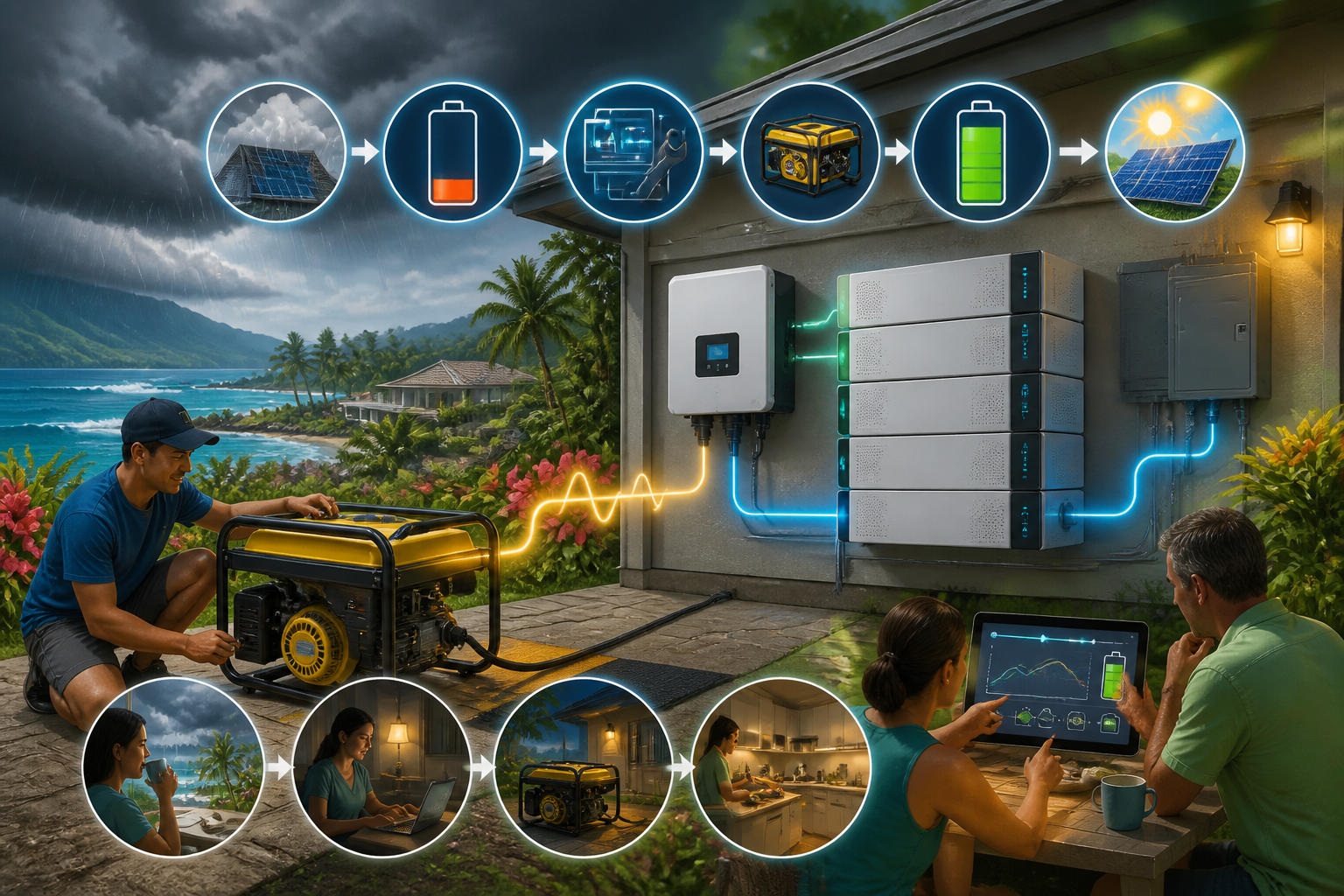
On an off-grid system, a generator is not just an emergency engine sitting outside. It can give your Pytes V16 battery bank a planned way to recover after several cloudy days, when the solar array has not put enough energy back into storage.
I like this approach because it lets the battery do its normal job while the generator fills the gap. The generator feeds the compatible inverter-charger through its AC input. The inverter-charger then controls the battery charging process, while the battery continues supporting the home as the system allows.
Start with the battery’s charging number
The Pytes V16 is a 51.2-volt, approximately 16-kilowatt-hour lithium iron phosphate battery. Pytes lists a recommended charge current of 125 amps, which works out to about 6.4 kilowatts on the battery side: 51.2 volts × 125 amps = 6,400 watts.
That is a useful planning number, not a command to charge every V16 at exactly 125 amps. The compatible inverter-charger may have its own battery-charge setting, and the complete system must also account for conversion losses, battery temperature, the state of charge, and the number of V16 units connected in parallel.
With two V16 batteries, the same simple calculation gives approximately 12.8 kilowatts at the recommended combined charge current. That does not mean your generator must deliver 12.8 kilowatts of AC power. The inverter-charger is converting AC from the generator into DC for the batteries, and the generator may also be serving household loads. Those numbers have to be matched rather than guessed.
Generator size is more than battery charging
When I plan this part of a system, I separate three loads:
- the power going into the battery bank;
- the power the inverter-charger consumes while doing that work; and
- the household loads that may run at the same time.
For example, if an inverter-charger is set to send roughly 4 kilowatts into one V16, the generator needs enough usable AC capacity for that charging demand, the inverter’s conversion losses, and any important loads running in the house. A smaller generator may still work if the charger is limited to a lower current. A larger generator is not automatically better if the inverter-charger cannot accept its output or if the generator operates inefficiently at a very light load.
This is why I want to see the exact inverter-charger model before recommending a generator. The inverter’s AC input rating, charger limit, generator-input requirements, and automatic generator-start capability matter just as much as the V16’s battery numbers.
Communication keeps the recovery controlled
The Pytes V16 provides battery-management communication through its documented communication ports and supports parallel expansion. In a properly matched system, the battery-management system can help the inverter understand battery status and operating limits. That is much better than treating a large lithium battery as a simple voltage source.
The communication path still has to be confirmed for the exact inverter model, firmware, cable, and battery arrangement. Closed-loop communication is not proven merely because both pieces use a 51.2-volt battery platform. If the inverter does not have an approved communication profile, the system may require carefully documented open-loop settings instead.
For a multi-battery bank, I also want the parallel batteries, communication connections, and primary-battery arrangement planned before commissioning. A generator recovery cycle is not the time to discover that one battery is reporting correctly while the others are not participating as intended.
Use the generator as a recovery tool
After a cloudy stretch, I would first look at the battery state of charge, the forecast, and the expected household loads. If another sunny day is likely and the battery has plenty of reserve, the generator may not need to run. If the battery is approaching the system’s low-battery threshold, a controlled charging session can restore useful reserve before the weather improves.
The charge setting should be conservative enough for the generator and appropriate for the V16 bank. The inverter may also use a start threshold, a stop threshold, or a state-of-charge target for automatic generator control. Those settings should be tested during commissioning, not assumed to work because the generator starts successfully.
One V16 stores about 16 kilowatt-hours at the nameplate level. Replacing half of that energy would require roughly 8 kilowatt-hours delivered to the battery before accounting for inverter losses and charging behavior. At a 4-kilowatt battery-side charge rate, that is about two hours of ideal charging time. Real recovery takes longer when the home is using power at the same time, the charge rate tapers near full, or the generator is limited.
Where this fits in a Hawaii system
This arrangement makes the most sense for a remote home, cabin, farm, or whole-home backup system where cloudy weather can last long enough to change the battery plan. The V16’s outdoor-rated enclosure and 16-kilowatt-hour class of storage give the system meaningful reserve, while a properly sized generator provides another source when solar production falls short.
I would not choose the generator separately from the inverter-charger. I would match the generator, charger settings, V16 bank size, communication method, automatic-start controls, and household loads as one plan. If you’re considering a Pytes V16 system, contact SolarMan and I can help compare your overnight loads, generator size, and inverter-charger options before the clouds arrive.