The Fortress ENVY DUO 21 gives us an interesting option when a customer wants a large hybrid inverter but does not want to be limited to one battery brand. Fortress Engineering directly confirmed to SolarMan that the ENVY DUO 21 supports the Pytes V16. That gives us a real starting point for evaluating the pairing—not a reason to skip the engineering work that comes after it.
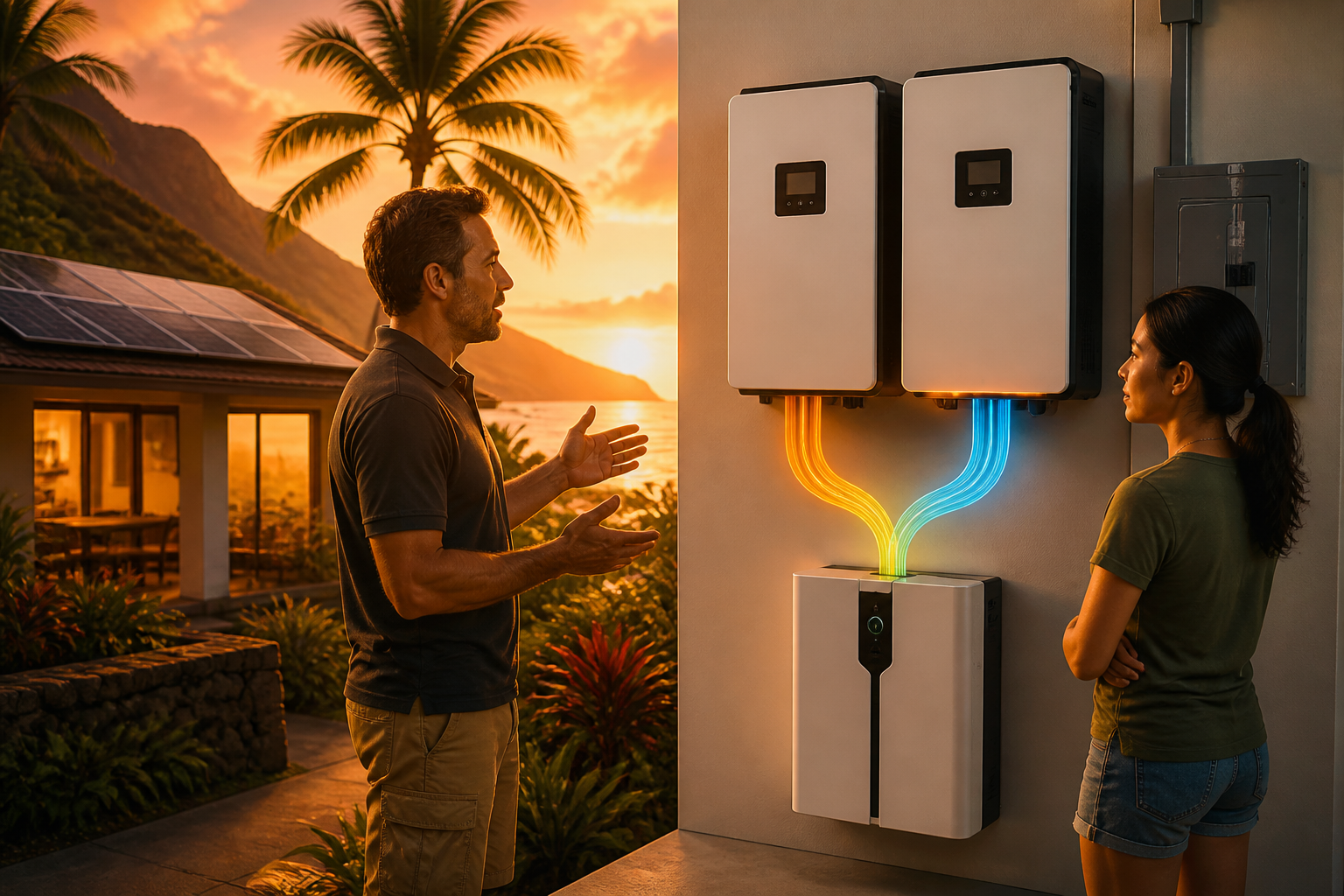
When I say the battery and inverter need to “talk,” I mean more than having similar voltage numbers. The battery-management system, or BMS, may need to report state of charge, temperature, charge limits, discharge limits, and alarms to the inverter. The inverter then uses that information to control charging and protect the battery. Without the right communication method, a system may still move power, but it may not have the coordinated control we want.
The electrical match deserves a quick reality check
The ENVY DUO 21 is a 48-volt-class inverter with a documented battery voltage range of 40 to 60 volts. Fortress lists 12,000 watts of continuous output when operating from battery power and a maximum battery charge and discharge current of 250 amps.
The Pytes V16 is rated at 51.2 volts and 16 kilowatt-hours. Pytes lists a recommended discharge current of 150 amps, which is approximately 7.68 kilowatts at nominal voltage. Its maximum continuous charge or discharge current is listed as 200 amps, or approximately 10.24 kilowatts at nominal voltage. Those figures are useful planning numbers, but they are not the same as promising that one V16 will deliver the ENVY DUO 21’s full 12-kilowatt output continuously.
That is why battery count matters. Two V16 batteries provide more current-sharing capacity than one, but the final design still depends on the loads, starting surges, battery limits, cable layout, inverter settings, and the exact operating conditions. I would rather size that honestly than tell you that a 16-kilowatt-hour label automatically means the battery can support every load your home may place on a 12-kilowatt inverter.
A communication port is not proof of compatibility
The public ENVY DUO 21 documentation shows battery communication through CAN and RS485 interfaces. The Fortress installation manual also documents the battery communication port and its signal assignments. Pytes publicly documents CAN and RS485 ports on the V16, along with the battery’s communication pin assignments.
That is encouraging, but CAN and RS485 are communication families—not universal languages. The devices still need the correct protocol, message map, port selection, cable arrangement, termination, and software behavior. A cable that fits an RJ45 socket does not automatically make two products compatible. I would also want the applicable firmware versions and any approved configuration profile identified for the exact ENVY DUO 21 and V16 revisions being supplied.
This is the part many customers never see. The system may look electrically simple from the outside, yet the BMS conversation determines whether the inverter knows when to reduce charging, limit discharge, or respond to a battery alarm. Good communication can make the system easier to monitor and support. Bad or incomplete communication can leave the installer relying on conservative manual settings or troubleshooting a problem that began with the wrong profile.
What I would confirm before commissioning
First, I would identify the exact ENVY DUO 21 revision, the exact V16 documentation revision, and the intended battery count. Then I would confirm the approved communication path rather than assuming CAN and RS485 are interchangeable. The cable, port, protocol selection, firmware, and inverter settings all belong on the commissioning plan.
After the power connections are complete, the installer should confirm that the inverter actually sees the battery data it is supposed to see. I want to know that the displayed battery state, voltage, current, alarms, and charge or discharge limits make sense before the household depends on the system. For a Hawaii backup or off-grid installation, that calm staged startup is worth the extra attention.
Fortress Engineering’s direct confirmation makes the Pytes V16 worth evaluating with the ENVY DUO 21. It does not, by itself, tell us the cable, firmware, menu selection, or closed-loop settings for every revision. If you are considering this combination, contact SolarMan with your expected loads, backup goals, and battery location. I can help determine whether the ENVY DUO 21 and Pytes V16 make sense as one properly coordinated system.
For a general lesson on why the communication layer matters, Kvaser’s video CAN Protocol Course: The CAN Physical Layer (Part 4) explains how CAN signaling, cable behavior, and termination affect a working communication link. It’s useful background when you’re comparing battery and inverter ports, even though your final system still needs the exact approved protocol and settings.