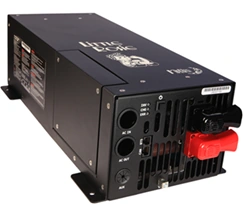
With Little Rosie, I start with the place where the power system will live—not the biggest number on the label. MidNite's current owner manual describes the stationary MNLR4548RE for houses, offices, and cabins. The related MNLR3648M is the mobile version for recreational vehicles, trucks, and boats.
They share a lot of useful hardware. Both are 120-volt true-sine-wave inverter/chargers with a 60-amp battery charger and a 30-amp internal transfer relay. But they are not interchangeable just because they look similar. The electrical environment matters.
The stationary model fits a building system
The MNLR4548RE makes sense when the inverter will serve a stationary 120-volt system. It can turn battery direct current (DC) into household alternating current (AC), charge a 48-volt battery bank from a qualified AC source, and pass incoming AC through to the loads when that source is available.
For output planning, the current owner manual specifies 4,500 volt-amperes (VA) of continuous output at 25°C. MidNite's product page also describes the model as 4,500 watts, but VA and watts are not identical for every load. I treat 4,500 VA as the published inverter rating and then look closely at the actual loads, power factor, battery capability, and motor starting demand.
The manual lists 6,750 watts for five-second surge on the stationary model. That can be useful for a refrigerator, pump, compressor, or other motor load, but surge is not a promise that every difficult load will start. The battery bank, cable path, temperature, and the load's real starting behavior still have to cooperate.
The mobile model solves a different problem
MidNite describes the MNLR3648M for recreational vehicles, trucks, and boats. Its mobile owner manual explains the neutral-to-ground switching relay that changes behavior between inverter operation and an external source such as shore power or a generator. That arrangement is part of why a mobile inverter is a different choice from a stationary building inverter.
The mobile model's current manual specifies 3,600 VA of continuous output at 40°C. Its five-second surge is listed as more than 5,400 watts. Notice that the continuous ratings use different temperature references: 25°C for the stationary model and 40°C for the mobile model. I would not turn those into a simple apples-to-apples watt contest.
Neutral and listing details deserve a careful check
The MNLR4548RE manual says the stationary model has common input and output neutrals, the arrangement normally used in a house, office, or cabin. It identifies the stationary model with UL 1741 and CSA C22.2 No. 107.1-01. The MNLR3648M manual describes the mobile neutral-to-ground relay and lists UL 458, UL 1741, and CSA C22.2 No. 107.1-01.
There is a documentation wrinkle I would not wave away. MidNite's current online product pages display a shared Little Rosie feature list that also shows internal neutral-to-ground switching and UL 458 on the stationary product page. Because neutral bonding and listings affect the installation, I want the exact model and revision paperwork confirmed before ordering rather than relying on a generic product bullet.
How I would apply the choice
For a Hawaii cabin with a refrigerator, lights, communications equipment, and selected backup loads, I would begin with the stationary MNLR4548RE. Then I would match the battery bank and protection equipment to those loads and add a separate MidNite maximum power point tracking (MPPT) charge controller for the solar array.
For an RV, truck, or boat using shore power or a generator, I would begin with the MNLR3648M's mobile requirements. The neutral behavior, marine or vehicle listing, temperature reference, and available battery power matter just as much as the 3,600-VA rating.
The Pacific Yacht Systems lesson below gives a useful general explanation of marine inverter/charger operation. It focuses on shore-power behavior, keeping the charger active when appropriate, understanding connected loads, and avoiding unnecessary battery drain.
If you're deciding between a cabin system, home backup system, RV, truck, or marine installation, contact SolarMan before ordering. Tell me where the inverter will live, which loads you want backed up, what battery you are considering, and whether utility power, shore power, or a generator will be involved. I'll help you determine which Little Rosie model fits the system you actually want to build.