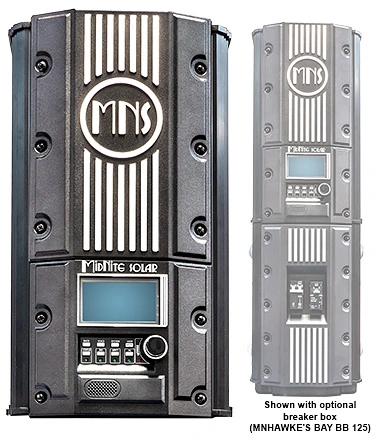
When a customer asks me whether to use the MidNite Hawke's Bay 90 or 120, I don't start with the bigger number. I start with the battery bank. These are both 48-volt maximum power point tracking, or MPPT, charge controllers. The real difference is how much current they can send into that battery bank: 90 amps for the Hawke's Bay 90 and 120 amps for the Hawke's Bay 120.
That gives us a useful first comparison. Using the nominal 48-volt battery label, 90 amps works out to 4,320 watts of charging power, while 120 amps works out to 5,760 watts. That is simple volts-times-amps arithmetic, not a promise that the controller will deliver those numbers all day. Battery voltage, solar conditions, temperature, settings, and available array power still control what actually happens.
The 90 is already a serious 48-volt controller
The Hawke's Bay 90 is not the small option. It is a high-voltage controller with a maximum operating input of 600 volts DC, an MPPT window from 185 to 585 volts, and an ideal open-circuit-voltage range listed by MidNite as 300 to 600 volts. It is designed for a 48-volt battery bank and can be configured for lithium, absorbed glass mat (AGM), flooded lead-acid, and other battery chemistries.
That high-voltage input can be valuable when the array is some distance from the battery and inverter equipment. A properly designed series string can move the same solar power at lower current, which can help manage voltage drop on a long run. The important word is properly: the string's cold-weather open-circuit voltage must stay within the Hawke's Bay limit, and the array's operating voltage must remain inside the controller's MPPT range.
I also want to keep two different current questions separate. The controller's 90- or 120-amp figure is its maximum battery-side charging output. That is not the same thing as the solar array's short-circuit current or the current the controller sees while tracking maximum power. Those numbers belong in separate design checks, especially with large or bifacial modules.
When the Hawke's Bay 120 earns its place
I would look harder at the 120 when the battery bank is large enough to accept more charging current and the solar array is sized to make use of it. The extra 30 amps is a one-third increase over the 90-amp model. On a nominal 48-volt calculation, that is about 1,440 additional watts of potential charging capacity.
That extra capacity can matter in an off-grid Hawaii system where the battery must recover during a limited stretch of good sun. It can also make sense when you are planning future array growth rather than replacing the controller later. But I would not choose the 120 simply because it is bigger. If the battery manufacturer limits charging current, or the array will never provide enough power to use the extra capacity, the 90 may be the cleaner match.
Both models use the same basic high-voltage PV approach, the same 48-volt battery platform, and the same general enclosure size. MidNite lists both at 17 5/8 by 9 by 8 1/8 inches and 23 pounds. So the decision is mainly about the electrical plan, not whether one unit is dramatically larger on the wall.
A natural match for a Rosie-based system
The Hawke's Bay becomes especially interesting when it is part of a MidNite system with a Rosie inverter/charger. The Hawke's Bay can communicate through MidNite's MNGP2 graphical interface and CAN bus network, allowing the controller and other compatible MidNite equipment to share a system view. That is useful because I would rather see the battery, solar charging, and inverter equipment as one coordinated system than as unrelated boxes.
The controller can also operate by itself, and the manual describes multi-unit networked installations with MidNite products that use the MNGP2. That gives you room to start with one charge controller and add capacity later when the battery bank or array justifies it. Any expansion still needs a fresh check of battery charging limits, overcurrent protection, conductor sizing, and the total solar voltage.
What I would want to see before recommending one
For a real proposal, I would want the battery model, its permitted charging current, the planned array wattage, the panel electrical specifications, the distance between array and equipment, and whether a Rosie or another compatible inverter is part of the system. I would also check the coldest expected design temperature before approving a high-voltage string.
One practical point is easy to overlook: the standard Hawke's Bay is indoor rated, so it needs a dry, protected equipment location. MidNite offers an optional Hawke's Bay breaker box and optional arc-fault, ground-fault, and rapid-shutdown modules where the system and local requirements call for them. Those choices belong in the complete equipment plan, not as last-minute add-ons.
My short version is this: choose the Hawke's Bay 90 when its 90-amp output matches the battery and array plan. Choose the Hawke's Bay 120 when the larger battery bank and solar array can genuinely use the additional charging capacity. If you send me your battery model, panel plan, and inverter choice, I can help match the controller to the rest of the system instead of guessing from the nameplate alone.
For a plain-language introduction to why MPPT controllers can work with a higher-voltage solar array than the battery bank, AltE Store's educational demonstration Comparing MPPT vs PWM charge controllers with a 24V panel and 12V battery is a useful starting point. It shows how an MPPT controller converts extra panel voltage into more charging current. It is a general lesson, not a review of the Hawke's Bay, but it explains the basic reason this type of controller can be valuable in a 48-volt system.