Yes, the Pytes V16 can be a serious battery candidate for a well or catchment pump. The important part is understanding that starting the motor is not just a battery question. I need to compare the pump, inverter, battery-management system, and wiring as one working system.
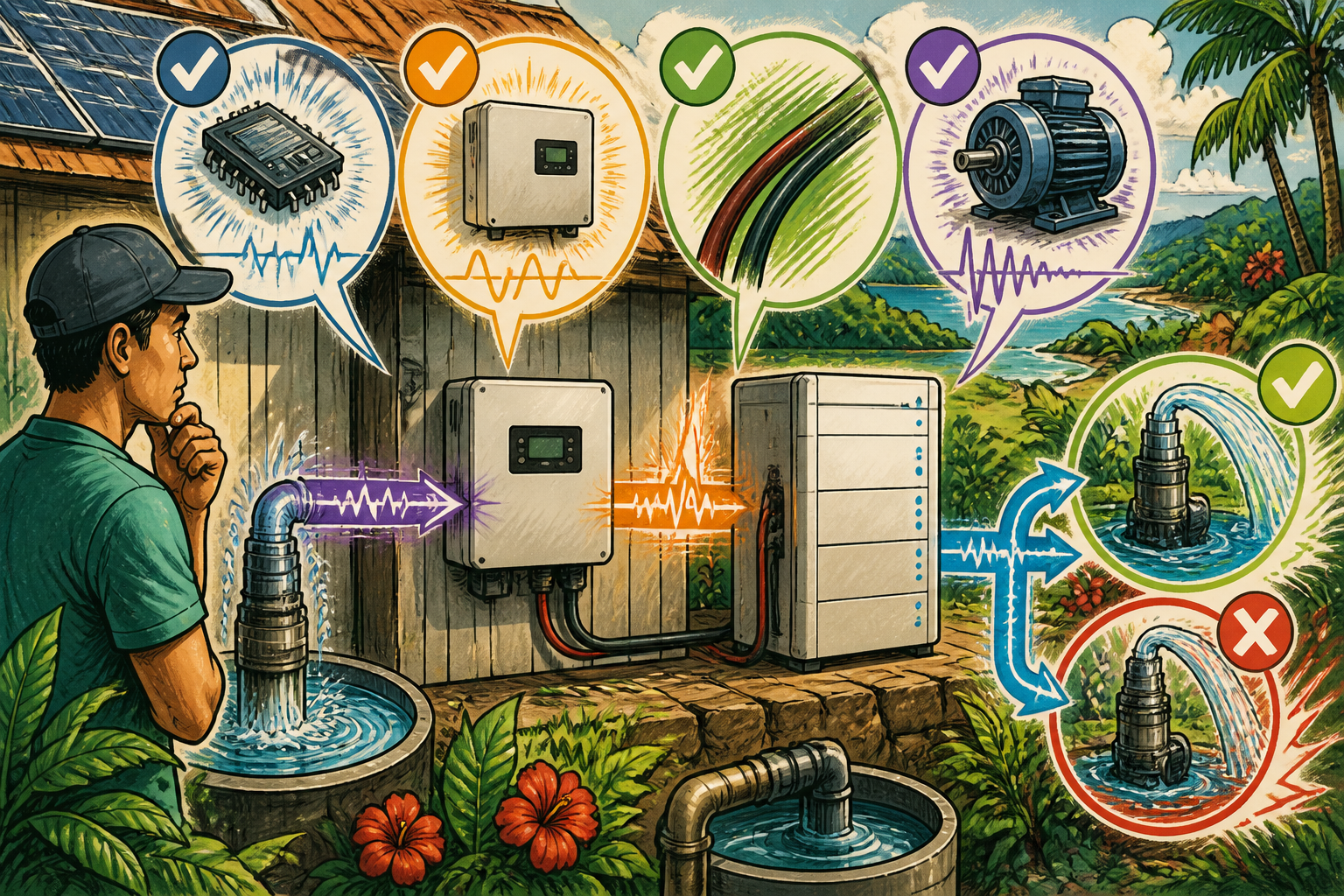
A pump may use modest power after it gets up to speed and still demand several times that amount for the first moments of startup. With the Pytes V16, I want to separate four questions: what the battery and its battery-management system (BMS) can deliver, what the inverter can produce on the alternating-current (AC) side, how much voltage is lost in the wiring, and how much current the pump motor demands while starting.
The V16 gives us a substantial starting point. It is a 51.2-volt lithium iron phosphate (LFP) battery with a rated energy capacity of 16 kilowatt-hours (kWh). Pytes lists a recommended discharge current of 150 amps. At the nominal battery voltage, that is about 7.68 kilowatts on the direct-current (DC) side: 51.2 V × 150 A = 7,680 W.
The datasheet also lists a 300-amp peak discharge current for 15 seconds. That works out to about 15.36 kW of nominal battery-side power before inverter losses. Those are useful design numbers, but they are not a pump-start guarantee. The inverter still has to convert that DC power into the correct 120- or 240-volt AC output and provide enough surge power for the motor.
The pump’s running amps are only half the story
For a proper evaluation, I need the pump model, voltage, horsepower, full-load running amps, and—when available—locked-rotor amps or starting-current information. Locked-rotor current is the high current a motor can draw before it gets moving. Grundfos notes that some conventional well-pump motors can reach up to seven times their nominal current during a direct-on-line start.
That does not mean every pump draws seven times its rating. It does show why running amps alone are not enough. A pump might operate comfortably within the inverter’s continuous output and still make the inverter voltage sag or trip when the motor first accelerates. I also want to consider what else is running at that moment, such as a refrigerator, pressure system, or other household load.
Battery surge and inverter surge do different jobs
The V16’s BMS manages the battery’s charge and discharge limits on the battery side, where current is measured at roughly 51.2 volts. The inverter’s surge rating is an AC-side specification. It tells us how much temporary motor-starting power the inverter can provide and for how long.
Those ratings must work together, but they are not interchangeable. I would not say, “The V16 can provide 15.36 kW, so it will start any pump.” The accurate statement is narrower: the V16 has a documented 15-second peak-discharge capability, and it may be a strong battery foundation when the selected inverter, pump, wiring, and controls are matched to that demand.
The V16 also provides CAN and RS485 communication ports for supported equipment. That can help an approved inverter profile receive battery limits and status information, but the ports alone do not prove closed-loop compatibility. The exact inverter model, communication profile, cable, and commissioning instructions still need to match.
Voltage drop can decide what happens at the pump
A pump may be close to the inverter, or it may be at the far end of a long run to a well, tank, or catchment area. During startup, the current rises sharply. Long conductors, undersized conductors, loose terminations, disconnects, and other connection points can add voltage drop right when the motor needs the strongest supply.
That can create a frustrating cycle: the motor struggles to accelerate, stays at high starting current longer, and causes an even larger voltage sag. The battery may be doing its part while the pump still fails to start reliably. Conductor sizing, run length, voltage, protection, and termination quality all need to be checked by a qualified electrician.
Sometimes gentler motor starting is the better answer
If the pump’s direct-start surge is too hard for the inverter, the solution may be a pump controller, soft starter, or variable-frequency drive (VFD), provided that control is approved for the specific motor and pump. A gentler start can reduce instantaneous demand and voltage disturbance, but it does not remove the need to match the controller, motor, pump hydraulics, and inverter.
My practical answer is this: a Pytes V16 can be a strong candidate for a well or catchment pump system, especially when the design also needs substantial overnight storage. I would call it a good match only after comparing the pump’s actual starting data with the inverter’s surge specification, the V16’s BMS limits, and the complete cable path.
Send me the pump nameplate and the inverter model you’re considering. I can help you determine whether one V16 is a sensible starting point or whether the system needs a different inverter, additional battery capacity, gentler motor starting, or a dedicated pump strategy.