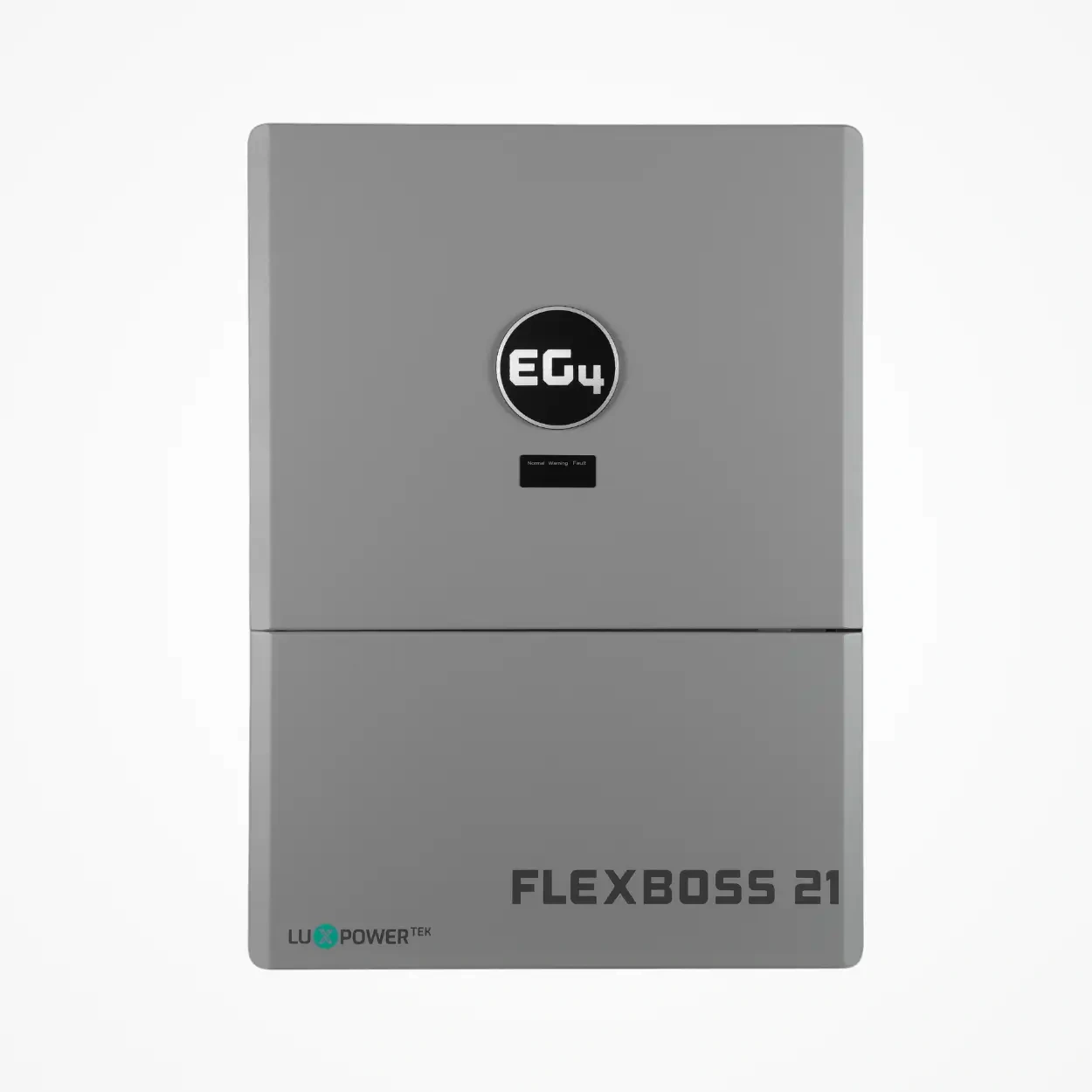
One reason I like the EG4 FlexBOSS21 is that you don’t have to make every future decision on day one. A single unit can be a serious 120/240-volt hybrid inverter for a Hawaii home, but the platform also gives us a path to add inverter capacity when the loads, solar array, or backup expectations grow.
That expansion is called paralleling. In plain language, multiple FlexBOSS21 inverters operate as one coordinated system instead of each inverter serving a separate little system. With the EG4 GridBOSS, the current architecture supports up to three hybrid inverters. The FlexBOSS21 manual also documents parallel operation beyond GridBOSS, with up to 16 units in a properly designed system.
What one FlexBOSS21 already brings
A single FlexBOSS21 provides up to 12 kilowatts of continuous output from the battery when photovoltaic, or PV, power is not adding to the inverter output. With PV and battery support available, EG4 documents up to 16 kilowatts of continuous output in the applicable operating condition. That gives one unit a lot of room for a typical backed-up home, especially when we identify the loads that truly need to operate during an outage.
The battery still has to be able to supply that power. Adding a second inverter does not make a small battery bank stronger. It increases the possible inverter output, which means the battery bank, battery-management system, bus equipment, and conductors all need to support the larger demand. I want those pieces matched before I promise a customer that more inverter capacity will improve the system.
When adding a second unit makes sense
Here’s the useful arithmetic. One FlexBOSS21 represents 12 kilowatts of battery-only continuous output. Two represent 24 kilowatts. Three represent 36 kilowatts. If PV is available and the system is operating in the documented PV-assisted condition, the corresponding figures are 16, 32, and 48 kilowatts.
Those numbers describe inverter capability, not a guarantee that your home will use or receive that much power. Your battery bank may be the limiting factor. So may the service equipment, the GridBOSS configuration, the load distribution, or the actual starting behavior of pumps, compressors, and air-conditioning equipment.
I might look at a second FlexBOSS21 when a customer has several large simultaneous loads, a larger battery bank, or a small commercial application that needs more continuous inverter capacity than one unit can reasonably provide. It can also make sense when the customer wants a larger solar and storage system without abandoning the FlexBOSS21 platform.
GridBOSS keeps the larger system organized
The GridBOSS is not another inverter. It is a service-entrance-rated power gateway that coordinates utility power, backed-up loads, non-backed-up loads, hybrid inverters, a generator, and smart or AC-coupled ports. EG4 rates it for up to 200 amps of service pass-through and up to three 90-amp hybrid-inverter connections for the FlexBOSS21 arrangement.
That 200-amp number is important, but it needs to be understood correctly. It describes the GridBOSS connection and pass-through capability. It does not mean one FlexBOSS21 produces 200 amps from its battery. The inverters still have their own output ratings, and the battery bank still has its own charge and discharge limits.
With multiple FlexBOSS21 units, the system also needs a clear master-and-parallel configuration. EG4’s documentation says the lithium battery’s host communication should connect with the inverter designated as master. Settings for the parallel inverters need to stay coordinated, and changes are made in standby mode. This is system commissioning work, not a casual add-on after everything is already operating.
Start with today’s loads, then leave a path forward
I don’t recommend buying extra inverters simply because the maximum number sounds impressive. I’d rather start with your actual loads, battery plans, solar production, service entrance, and outage priorities. If one FlexBOSS21 fits those requirements, it may be the cleanest starting point. If the design is already pushing beyond that capacity, we can evaluate two or three units from the beginning.
For a broader planning lesson, AltE Store’s 6 Steps to Design a DIY Off Grid Solar Power System is useful. It puts loads, battery storage, solar, inverter selection, and balance-of-system decisions in order. That is the right mindset here: adding inverter capacity only helps when the battery and the rest of the system grow with it.
Bring me your major loads, battery plans, solar-array goals, and service information. I can help you decide whether one FlexBOSS21 is the right answer now, or whether it makes more sense to build around a scalable two- or three-inverter system.