The best Rosie 7048 conversation starts with your actual loads, not a guess based on the size of your house. If you bring me a few useful measurements, I can tell much more quickly whether the Rosie is a sensible center for your Hawaii backup or off-grid system, what should be powered together, and where a generator may help.
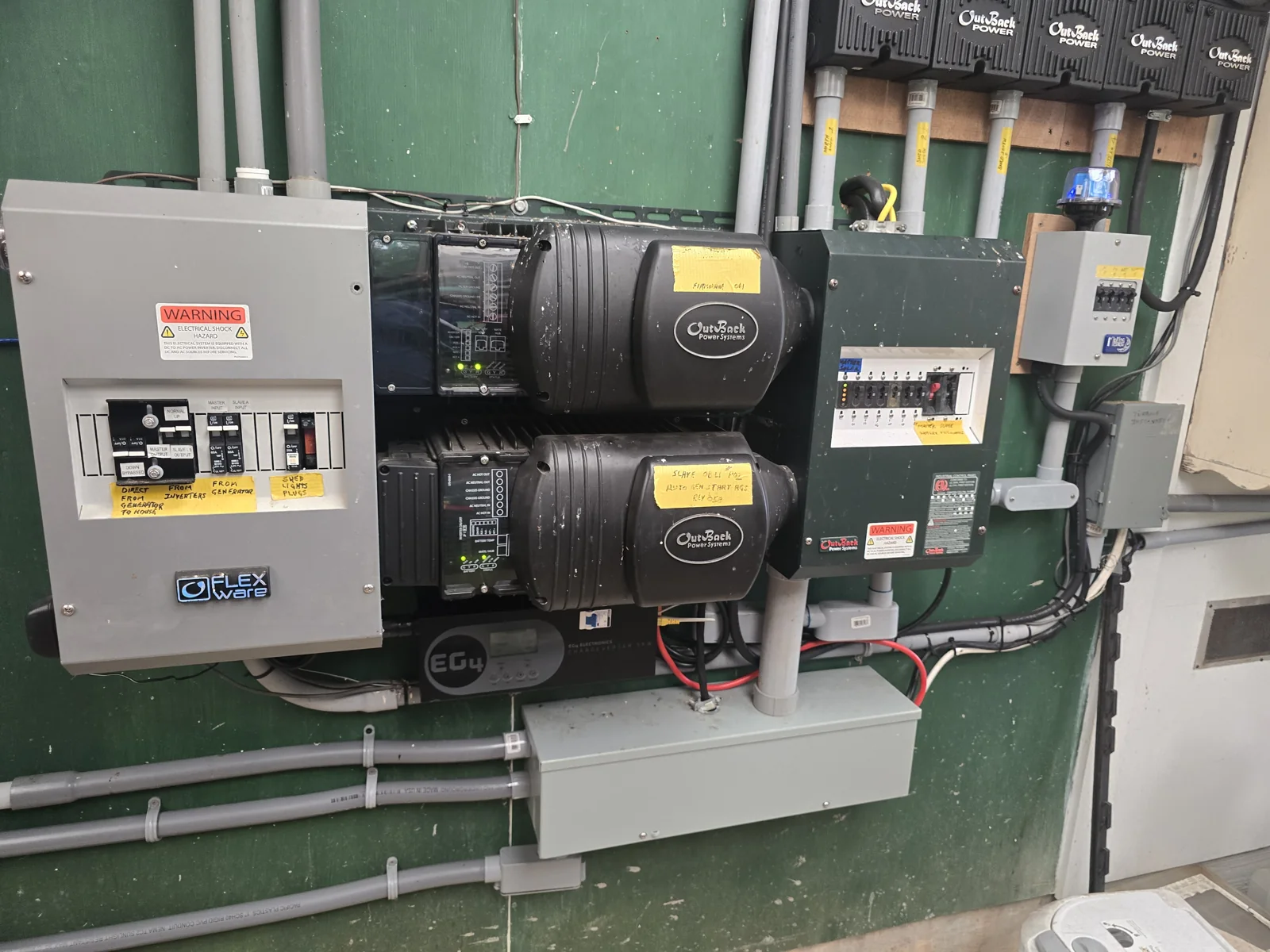
I’m looking for four things: the loads that run at the same time, the loads that surge when they start, the energy you use after sunset, and the generator plan you want the system to support.
Show me what can be running together
Write down the equipment you may use at the same time. Include refrigerators, freezers, pumps, air conditioning, water heating, cooking equipment, well or catchment equipment, laundry, shop tools, and ordinary plug-in loads.
For each item, record its voltage if you know it—120 volts or 240 volts—and its running watts or amps. For a simple direct-current load or resistive alternating-current load, volts multiplied by amps is a useful watt estimate. With motors, compressors, and some electronic equipment, that multiplication may describe apparent power rather than the real watt demand, so use measured watts or manufacturer data when it’s available. Also mark whether the load is essential, flexible, or something you would rather run only when the sun is strong or the generator is operating.
The stationary MNROSIE7048RE Rosie 7048 is a 48-volt, 7,000-watt inverter/charger with 120/240-volt split-phase output. That gives us a strong starting point, but the important question is still how your loads behave together. A house that uses 2,500 watts most of the time can still create a difficult event if a pump, compressor, and air conditioner all start during that same moment.
Find the starting surge before we promise a motor
Motors and compressors often need a short burst of power when they start. The running number on a pump or air conditioner does not tell the whole story. Look for locked-rotor amps, starting amps, or a manufacturer’s startup requirement. If that information is missing, an electrician can measure the starting event with the proper meter.
Here’s the kind of example I want to see. If a pump runs at 1,800 watts but reaches 5,000 watts during startup, I need both numbers. The 1,800 watts affects the normal load calculation. The 5,000-watt event affects whether the battery, inverter, and wiring can hold the voltage steady while the motor starts.
MidNite gives the Rosie substantial surge capability, and that is one reason I consider it for homes with pumps and other demanding loads. I still won’t call a motor compatible from the nameplate alone. Battery discharge capability, battery voltage sag, cable losses, pressure conditions, temperature, and the motor’s actual starting behavior all matter.
Measure the hours after sunset
For an off-grid system, overnight energy is often more useful than a monthly electric bill. Tell me what stays on from sunset until morning and how long it normally runs. A refrigerator may cycle instead of running continuously. A water pump may run for only a few minutes at a time. Internet equipment, security devices, fans, lights, and medical equipment may run for many hours.
Power is measured in watts. Energy is measured in watt-hours. A 100-watt device running for five hours uses about 500 watt-hours, or 0.5 kilowatt-hours. A plug-in energy meter can help measure equipment with changing consumption, and your utility bill can help establish a broader daily pattern for a grid-connected home.
Bring me your normal night and your difficult night. If you regularly run air conditioning after sunset, say so. If you only need it during an occasional hot spell, that leads to a different battery and generator conversation.
Decide what the generator is supposed to do
The Rosie 7048 includes an AC charger and an Auto-Gen Start menu, so I want to know how you expect the generator to participate. Is it emergency backup after several cloudy days? Is it there to start a large pump? Do you want it to carry household loads while charging the battery, or mainly recover the battery when its state of charge gets low?
Bring the generator’s model, fuel type, rated output, 120/240-volt capability, and any information about two-wire automatic start. Also tell me about your preferred operating hours and noise limits. A generator plan is not just “how many watts does it make?” It is also about how the generator behaves with changing loads and how much charging capacity the battery bank can accept.
AltE’s battery-bank sizing lesson is useful preparation because it shows how daily energy use, battery voltage, depth of discharge, temperature, inverter efficiency, and days of autonomy affect storage planning. I like that lesson as homework before we talk about a specific Rosie design.
When you’re ready, send me your appliance list, the largest motor or compressor details you can find, a typical overnight estimate, and your generator information. I’ll help turn those measurements into a practical Rosie 7048 conversation instead of asking you to design from guesses.