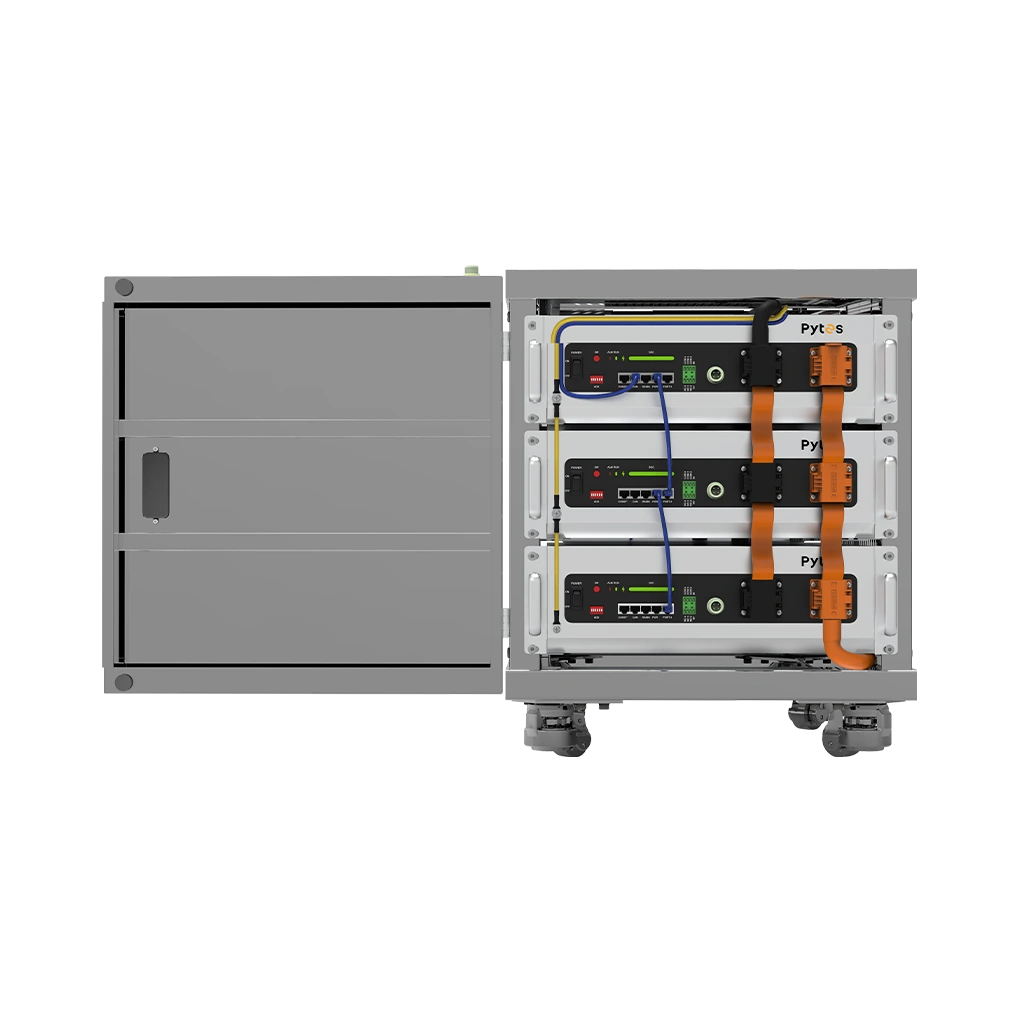
I like the Pytes V5 because it gives a Hawaii customer a useful combination: a 51.2-volt, 100-amp-hour battery that fits a rack or cabinet, can communicate with a compatible inverter, and can grow into a larger bank later. But the part I want you to plan correctly from the beginning is the battery’s environment.
The V5 is an indoor battery, not an outdoor box. Its enclosure is rated IP20, so I would place it in a dry, protected room rather than under an open carport or exposed lanai. A clean battery room, utility room, garage area, or purpose-built cabinet can make sense when the final location satisfies the manufacturer’s installation requirements and local rules.
Temperature matters most when the battery is charging
Pytes lists the V5’s charging range as 32°F to 113°F, or 0°C to 45°C. Discharging is allowed over a wider range, from 14°F to 122°F, or -10°C to 50°C. That difference is important. A battery may still be able to provide power in conditions where charging needs to be limited or paused.
That is usually not a major issue in a typical lowland Hawaii home. It can matter in a cool garage, an unconditioned room at elevation, or a battery space that drops sharply overnight. I don’t want the battery location chosen only because there is an empty shelf. I want to know what temperature that shelf actually sees during the part of the year when the system is most likely to charge.
The self-heating option helps, but it is not free heat
For the V5° version, Pytes lists an integrated heating film. The documented control points are approximately 41°F for turning on and 59°F for turning off. Pytes also describes heating operation in very cold ambient conditions, down to about -0.4°F, to bring the battery back toward its charging range.
Here is the detail customers sometimes miss: the heater needs an external charging source, such as photovoltaic power, the grid, or a generator. It is not a stand-alone room heater, and it does not create extra battery energy. If the battery is cold and there is no available charging source, the heating function cannot solve that situation by itself.
That makes the heating option valuable for the right installation, not a reason to ignore placement. I still prefer a dry, sheltered, reasonably stable battery location. The heater is another layer of protection when temperature occasionally becomes the problem.
Start with the battery you actually have
Pytes has several related products that can look similar in a catalog. The V5° uses PHOENIX M6 bolt power terminals, while the V5°α uses Amphenol SurLok Plus terminals and its own parallel power cables. I would match the exact label on your battery to the applicable manual before ordering cables, planning a rack, or selecting a communication harness. A nearby model is not automatically interchangeable.
The V5 stores 5.12 kilowatt-hours on a nameplate basis: 51.2 volts multiplied by 100 amp-hours. Its recommended continuous charge and discharge current is 75 amps, or about 3.84 kilowatts at nominal voltage. The 100-amp maximum is about 5.12 kilowatts at nominal voltage, but I treat that as a battery-side limit, not a promise that every inverter or household load can use that power continuously.
Pytes specifies those recommended and maximum current figures with the battery cell temperature between 50°F and 104°F. Outside that cell-temperature range, the battery can derate its current. That is another reason I want the temperature plan settled before I decide how many batteries the inverter and household loads need.
Commissioning should confirm the conversation
Once the battery is in the right place, the inverter and battery need to agree on the communication protocol. The V5 provides CAN and RS485 communication options, but the correct port, cable, protocol selection, and inverter settings depend on the inverter model. For example, Victron’s current Pytes guidance requires a GX device for battery-management communication and says the battery must appear on that device before dependent settings are changed. That is a system-specific example, not a universal setting for every inverter.
My handoff goal is simple: the battery powers up normally, the inverter recognizes the battery, state of charge is believable, charge and discharge limits are being received, and there are no unexplained alarms. If those pieces are right, the V5 becomes much easier to live with than a battery that is merely connected and forgotten.
If you are considering a Pytes V5 for backup, self-consumption, or an off-grid system, contact SolarMan before choosing the rack location. I can help match the exact V5 version, inverter communication path, battery quantity, and temperature plan to the system you actually want to operate.