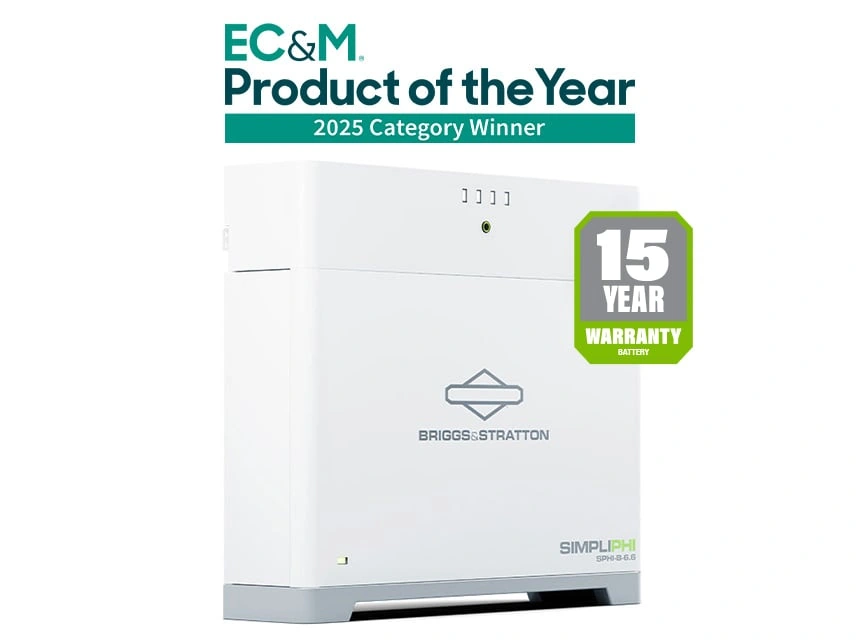
When a customer tells me, “I want backup power, but I don’t know how many batteries I need,” I don’t start by guessing at a number. With the Briggs & Stratton SimpliPHI 6.6, I start with the loads you want to keep running and how long you want them to operate.
What I like about this battery is that it lets us grow the energy storage without automatically changing the inverter. That gives us more room to match the system to your home instead of buying a larger package than your loads require today.
Start with energy, then check power
Each SimpliPHI 6.6 battery is rated at 6.656 kilowatt-hours and uses a nominal 51.2-volt battery system. Kilowatt-hours describe stored energy—roughly, how long the battery can support a load. Power describes how much demand the battery and inverter can handle at one time.
The battery’s 130-amp continuous-discharge rating works out to about 6.66 kilowatts on the nominal battery side: 51.2 volts × 130 amps. That is not a promise of 6.66 kilowatts of alternating-current output at the house. The inverter, its own limits, the battery bank, wiring, and the load’s starting behavior still have to agree.
What one, two, or three batteries change
- One battery: 6.656 kWh of rated storage
- Two batteries: 13.312 kWh of rated storage
- Three batteries: 19.968 kWh of rated storage
Those figures are nameplate energy values. Briggs & Stratton states that the rated energy is measured at a 0.75C discharge rate and 100% depth of discharge. Actual energy delivered to your AC loads will be lower after inverter losses, reserve settings, temperature effects, and the loads operating at the same time.
Adding batteries gives you more stored energy, and an approved battery-and-inverter configuration may also support more battery-side current. It still does not automatically increase the inverter’s AC output. The exact system limits and communication setup have to be checked together.
Here’s a simple way to see the difference. A steady 1,000-watt load would use about 1 kilowatt-hour in an hour before losses. One battery gives you a different reserve than three batteries, but neither number tells us whether the system can start a well pump, carry an air conditioner, or run several large loads together. That is where inverter output and surge capability enter the design.
RapidStak gives expansion a cleaner path
The RapidStak connector brings power and communications together as the batteries are stacked. Within one stack, the batteries do not need a separate web of battery-to-battery power cables or manual DIP-switch settings. A stack can contain one, two, or three batteries, with the battery controller mounted on top.
That makes staged planning practical. You might begin with refrigerator, lighting, internet, controls, and selected outlets, then add another battery later for longer outage coverage or more evening energy. If we use multiple stacks, the controllers still need the communication connections and termination required by the installation manual. Expansion is straightforward, but it is not just a matter of placing another battery wherever there is room.
The inverter needs a clear battery conversation
The SimpliPHI 6.6 supports CAN, or Controller Area Network, and RS-485 communication, and Briggs & Stratton publishes integration material for supported inverter families. In a documented closed-loop pairing—meaning the inverter receives operating information from the battery—the two pieces of equipment can coordinate around the battery system’s limits. The exact communication adapter, settings, and supported functions depend on the inverter integration guide.
That is why I want to know the inverter before I finalize the battery count. A larger battery bank does not automatically make a smaller inverter larger, and a battery that can communicate with one inverter family is not automatically configured for every 48-volt inverter.
Outdoor-rated still means properly installed
The SimpliPHI 6.6 is listed as IP20 by itself and IP65 when installed as a system. That outdoor rating gives us useful placement flexibility, but it does not remove the need for correct mounting, drainage, clearances, service access, and protection from avoidable physical damage. Briggs & Stratton also lists corrosion and salt-fog ratings that are worth considering in Hawaii.
The benefit is flexibility. Depending on the site and the applicable requirements, we may be able to use a wall-mounted or ground-mounted location indoors or outdoors instead of giving up valuable indoor utility space.
Where I’d consider the SimpliPHI 6.6
I’d look closely at this battery when you want backup power, solar-plus-storage, time-of-use energy management, or an off-grid system that can grow. It makes particular sense when we can choose the inverter and communication path early, then size the battery bank around your real loads and backup priorities.
If you want to see the idea in physical form, Solar Builder’s The Pitch conversation about the SimpliPHI 6.6 explains why RapidStak matters, why the inverter remains separate from the battery, how storage capacity can be scaled, and why battery communication matters when choosing compatible inverter equipment. It’s a helpful product lesson before we get into the details of your own system.
Bring me your important loads, your inverter preference, and how long you want backup power to last. I can help you compare one, two, or three SimpliPHI 6.6 batteries and build the rest of the system around the job you actually want the battery to do.