When I’m matching a large battery to a Sol-Ark inverter, I don’t start with the battery’s nameplate alone. I start by making sure the two pieces can actually exchange battery-management information. That is what makes the Pytes V16 and Sol-Ark pairing worth considering for a Hawaii backup or off-grid system.
The V16 is a 51.2-volt lithium iron phosphate battery with a 16 kilowatt-hour nameplate capacity. Pytes lists a recommended charge current of 125 amps, a recommended discharge current of 150 amps, and a maximum continuous charge or discharge current of 200 amps. Those numbers establish the battery side of the design, but they don’t replace load planning or inverter matching.
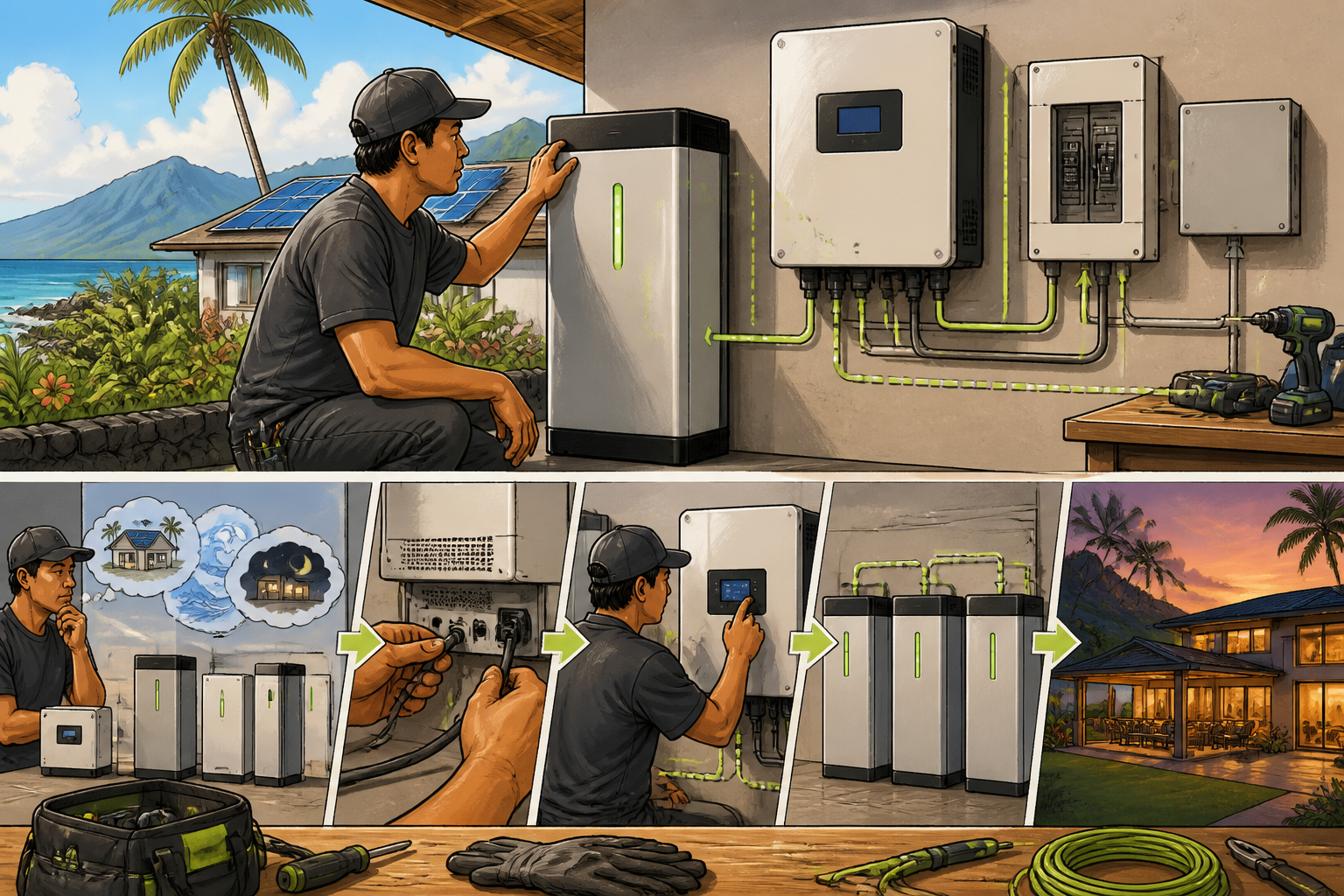
Start with the exact Sol-Ark model
Pytes’ V10α and V16 selection guide includes a V16 configuration with the Sol-Ark 15K-2P-N and a battery-to-inverter communication cable. Sol-Ark’s current low-voltage integration guide also lists Pytes V16 as a supported battery model. That gives us a credible starting point, but it does not mean every Sol-Ark carrying a “15K” or “18K” label should be treated as interchangeable.
The 15K-2P-N, 15K-2P-LV, and 18K-2P-LV are different inverter models and revisions. Their manuals, connector labels, firmware requirements, and approved battery instructions still matter. Before I finalize a customer’s design, I want the exact inverter model beside the exact V16 documentation—not just a general statement that both products use a 48-volt-class battery.
Use the documented battery path
The V16 has CAN and RS485 communication interfaces, but the inverter-side port is not chosen simply because both products mention those terms. For current outdoor Sol-Ark 15K and 18K systems, Sol-Ark’s integration guide specifies the V16 COM port to the inverter’s Battery CANBus port. The separate Modbus RS485 port is not the normal battery-communications port for those outdoor models.
Sol-Ark’s current V16 instructions also call for a standard Ethernet cable, switches 1 and 5 on for the master battery, the appropriate charge and discharge settings, and BMS Lithium Batt set to 00. The guide includes a different documented port arrangement for certain indoor legacy models. That is why I want the inverter model and current manual in front of me before anyone chooses a cable or port.
This distinction matters. A battery can be electrically close enough to run an inverter while still lacking a confirmed closed-loop communication setup. In my view, a clean communication plan is one of the reasons to consider the V16 in the first place. The Sol-Ark battery information screen can show values such as voltage, current, temperature, state of charge, and the charge and discharge limits being sent by the battery-management system.
One V16 or a larger bank?
One V16 stores 16 kilowatt-hours on paper. Two units provide 32 kilowatt-hours of nameplate energy, before reserve settings, conversion losses, temperature, and actual load shape are considered. If a home averages a 2-kilowatt load overnight, 32 kilowatt-hours gives us a simple starting estimate of 16 hours before those real-world allowances. That is a planning example, not a runtime promise.
Adding batteries also changes the communication plan. Pytes lists expansion up to 16 V16 units in parallel, or 256 kilowatt-hours, without a Pytes hub. The battery bank still needs the correct master arrangement, linked battery communications, current sharing, overcurrent protection, conductor sizing, and inverter limits. A larger bank can provide more energy and more available battery current; it does not automatically make every household load appropriate for the Sol-Ark output.
Commission it in a calm order
I would begin by checking the battery arrangement, DC connections, master-battery settings, and the exact communication path. Then I’d power the battery according to the V16 instructions, establish communication with the Sol-Ark, confirm that the inverter is receiving battery data, apply the documented battery settings, and bring the solar, grid, generator, and backed-up loads into service in stages.
For a Hawaii customer, this is where the V16 becomes more than a large box of stored energy. Its IP66 enclosure, C4-M corrosion resistance, integrated heating film, and wall- or ground-mount options give us useful outdoor-planning flexibility. Placement, service access, structural support, cable routing, and protection equipment still need to be designed around the actual property.
If you want a simple technical background lesson, SparkFun Electronics’ “How CAN BUS Works” explains how CAN carries messages, handles errors, and resists electrical noise. That helps make the practical point here: the right communication protocol and documented port matter more than the fact that a cable happens to use an RJ45-style connector.
I like the Pytes V16 with Sol-Ark when the system is planned as one conversation: exact inverter model, documented battery profile, approved communication path, properly arranged battery bank, sensible load priorities, and staged commissioning. If you’re considering this combination for a Hawaii home, cabin, or off-grid property, contact SolarMan and I’ll help compare the V16 configuration with your Sol-Ark model, loads, solar array, and backup goals.