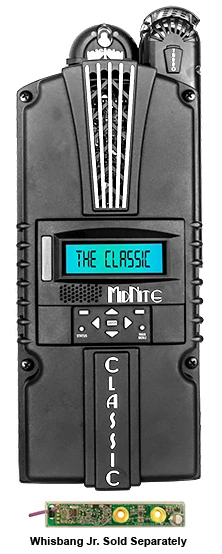
I like the MidNite Classic 150 most when a customer wants to understand what the battery bank is doing, not just watch a charging voltage move up and down. The controller can charge the bank by itself, but adding the optional Whizbang Jr current-sensing module gives it a much better view of the system.
That matters in an off-grid Hawaii system where the battery may be carrying evening loads, accepting solar during the day, and occasionally working with a generator. Voltage alone can be misleading while a battery is charging or discharging. The Whizbang Jr watches current through a 500-amp, 50-millivolt shunt, so the Classic can keep track of amp-hours going into and out of the bank.
The useful part is knowing the battery's state of charge
State of charge, or SOC, is the controller's estimate of how full the battery is. A properly configured Classic with Whizbang Jr can display instantaneous battery current, remaining amp-hours, and SOC on its status screen. That gives you a more useful answer than simply seeing, for example, 51 volts and assuming the battery is full.
There is an important setup step. The Classic needs to see a properly completed charge cycle and reach Float before it establishes the battery's 100-percent reference. Until that happens, the SOC display can flash rather than represent a calibrated reading. Battery capacity, efficiency, temperature settings, and the battery manufacturer's charging guidance all affect the result.
I also want to be clear about what this is and what it isn't. The Whizbang Jr does not magically test the chemistry inside the battery. It calculates from measured current and the settings you provide. Good settings and periodic review matter, especially as a battery ages or the system changes.
It can help the Classic finish charging more intelligently
The Whizbang Jr can also support an Ending Amps setting. During the Absorb stage, the Classic holds the battery at the programmed charging voltage while current gradually falls. If the measured battery current drops below the properly chosen Ending Amps threshold for the required period, the controller can move to Float instead of relying only on a fixed Absorb timer.
That can be useful, but I would not guess at the number. The correct threshold depends on the battery manufacturer's recommendation and the way the bank is built. Setting it too high can leave the battery undercharged. Setting it too low may mean the Classic never reaches the target through Ending Amps and falls back to the time-based behavior.
A practical generator-control relationship
For an off-grid customer, the most interesting relationship is between SOC and the Classic's AUX-1 output. After the Whizbang Jr has been installed, configured, and calibrated, the Classic can use SOC as one condition for controlling a compatible generator start circuit.
This is not a direct high-power generator connection. The Classic provides either a control voltage or a dry-contact signal, depending on its configuration, and that signal is intended for a compatible two-wire-start generator system or an appropriate external relay. MidNite specifically does not describe this AUX-1 method as support for three-wire generator sets.
For example, a system might be arranged so the generator receives a start signal when the battery reaches a chosen low SOC, then stops after the battery recovers to a chosen higher point, with delay and hold settings helping prevent rapid start-stop behavior. The actual values should come from the battery, generator, and system design—not from a generic internet setting.
Where I think this upgrade fits
This combination makes sense when you have a Classic 150 already supporting an off-grid battery bank, or when you want a controller that can remain useful as the system gains better monitoring and generator coordination. It is especially helpful when several loads and charging sources make battery voltage hard to interpret.
It is less compelling if you only need simple solar charging and already have a trustworthy battery monitor that serves as the one system reference. Multiple SOC meters can disagree, so I prefer choosing one properly configured monitor and using it consistently.
If you are considering a Classic 150, Whizbang Jr, or generator-control setup, contact SolarMan. I can help match the controller, battery type, shunt arrangement, generator interface, and charging settings to the system you actually want to operate.