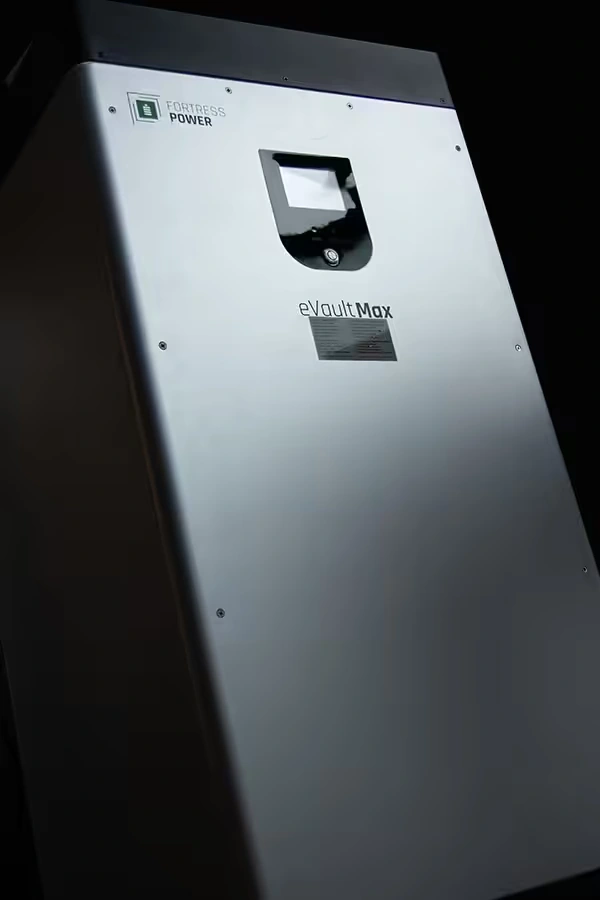
One reason I pay attention to the Fortress Power eVault MAX 18.5kWh is that it gives you a serious amount of battery energy in one cabinet, while still leaving a practical path for expansion. That matters when your first goal is backup power but you may eventually want more overnight coverage, more off-grid reserve, or a larger light-commercial system.
The eVault MAX stores 18.5 kilowatt-hours (kWh) of energy on a nominal 51.2-volt battery platform. In plain language, it is a large 48-volt-class lithium iron phosphate battery with its own battery management system, display, breaker, and communication ports. Fortress lists a recommended charge current of 150 amps and a maximum continuous discharge current of 180 amps.
The useful part is how the bank grows
Fortress designs the eVault MAX for parallel operation. That means the batteries work side by side at the same battery voltage. You do not put them in series to create a higher-voltage battery bank.
Here is the simple planning example:
One eVault MAX: 18.5 kWh.
Two in parallel: 18.5 + 18.5 = 37 kWh.
Three in parallel: 18.5 + 18.5 + 18.5 = 55.5 kWh.
The voltage remains the same, while the available storage and battery current increase with the number of matched units. That is a useful arrangement for a Hawaii customer who wants to start with one substantial battery and add another later, provided the inverter, wiring, protection, space, and communication plan are designed for that expansion from the beginning.
Capacity is not the same as backup power
I want to make one distinction clear because it prevents expensive misunderstandings. The 18.5 kWh number describes stored energy. It does not tell you how many appliances the system can run at once. That job belongs mainly to the inverter and the system’s continuous power rating.
For example, a battery may have enough energy to support a refrigerator, lights, internet equipment, water pumps, and selected kitchen loads through an outage, but the inverter still has to handle the starting surge and the combined running load. A large battery gives you more time and more reserve. It does not automatically turn a smaller inverter into a whole-home inverter.
Fortress’s installation manual uses 9 kW per eVault MAX as a general maximum output guideline when battery-inverter communication is not being used. Some approved systems can be designed differently with closed-loop communication, but that is not a number I would apply casually. I match the battery bank to the exact inverter model and its current integration guide.
Communication makes the system easier to manage
The eVault MAX includes CAN and RS485 communication, along with a built-in battery management system. The battery can operate without inverter communication, according to the manual, but closed-loop communication is recommended because it lets the inverter and battery share information about state of charge, limits, and protection conditions.
That is especially valuable in a larger bank. Instead of asking the inverter to operate from fixed assumptions, the battery can provide live operating information. Fortress publishes an inverter compatibility guide with minimum battery quantities for equipment such as Fortress Envy and Solo inverters, Sol-Ark models, Schneider equipment, and selected OutBack products. I use that guide as a starting point, then check the current inverter documentation before finalizing a design.
Where this battery fits well
I see the eVault MAX making the most sense when you need more than a small emergency battery. It can be a strong fit for a home with meaningful overnight loads, an off-grid property that needs a larger reserve, or a customer who wants a battery platform that can grow without changing to a different voltage class.
There are practical site requirements. The installation manual calls for indoor placement in a waterproof, clean, level area, and the cabinet weighs about 520 pounds. The product page lists an IP55 enclosure, but that should not be read as permission to place the battery outdoors without following the current installation requirements and local approval process.
The eVault MAX also carries a 10-year limited warranty, subject to the published operating conditions, sizing rules, registration, and professional installation requirements. Fortress lists up to 8,000 cycles at 80 percent depth of discharge in its current product information, so correct system design is part of protecting the value of the battery.
Fortress Power’s short closed-loop communication demonstration is useful because it shows the communication relationship rather than pretending the battery is a standalone box. It is a general product lesson, not a substitute for the exact inverter integration guide.
If you are considering whole-home backup, off-grid power, or adding storage to an existing solar system, send me your inverter model, major loads, and the kind of outage coverage you want. I can help you determine whether one eVault MAX is enough, whether parallel expansion makes sense, and which inverter and communication combination fits the system.