If you’re planning an off-grid home, guest house, workshop, or carefully managed backup system in Hawaii, you don’t always need to buy the biggest inverter on day one. Sometimes the better move is to start with a well-matched EG4 6000XP and leave a sensible path for expansion. That flexibility is one of the reasons I think this inverter deserves a close look.
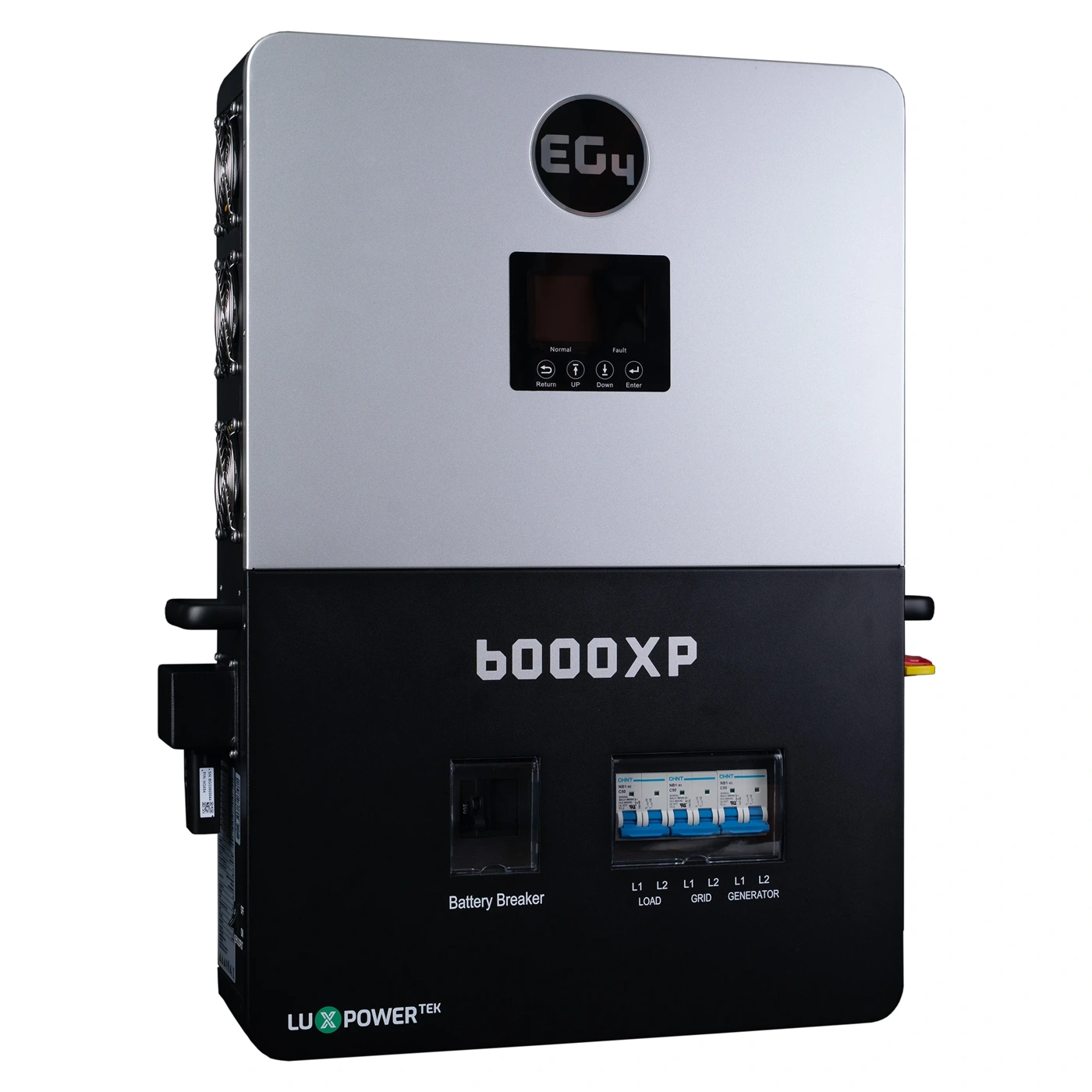
The EG4 6000XP is a 48-volt split-phase inverter/charger. One unit provides 120/240-volt output and is rated for 6,000 watts of continuous AC power. It also includes two Maximum Power Point Tracking (MPPT) solar inputs. The current manual lists 8,000 watts as the maximum utilized solar input and 10,000 watts as the recommended maximum solar input. That gives us room to plan, but it does not promise 10,000 watts of production all day.
Start with the loads you actually want to run
For a smaller home or essential-load system, one 6000XP can be a clean place to begin. The 120/240-volt output matters because the system can serve ordinary 120-volt circuits while also supporting suitable 240-volt equipment.
That 6,000-watt rating is a design starting point, not a promise that every appliance can run at once. I would look at your well pump, refrigerator, air conditioning, water heating, cooking equipment, and other large loads before deciding whether one inverter is enough. Motor starting current and the order in which loads operate matter just as much as the nameplate wattage.
Expansion is more than adding another box
EG4 documents parallel operation for up to 16 6000XP units. The basic arithmetic is easy: two units represent 12,000 watts of nominal continuous output, and three represent 18,000 watts. That is useful expansion potential, but each additional inverter brings another set of battery, solar, AC, communication, protection, and installation decisions.
Adding a second inverter does not automatically double the energy stored overnight. If the battery bank stays the same, the larger inverter bank may give you more simultaneous output, but it will not give you more hours of operation. The battery bank has to be sized for both the power you want to draw and the energy you want to store.
The same idea applies to solar. Each 6000XP has its own two MPPT inputs, so a parallel system needs a plan for dividing the array among the inverters. EG4 recommends putting more PV strings on the master inverter when an even division is not possible. String voltage, input current, array layout, and the inverter’s PV limits still need to be checked separately.
Communication is part of the expansion plan
Parallel inverters have to behave like one coordinated system. EG4’s manual calls for matching firmware, correctly wired power and parallel communication cables, proper DIP-switch settings, and correct phasing before commissioning. The primary or master inverter communicates with the battery bank, while the Battery Shared setting is enabled on the parallel units.
This is why I don’t treat expansion as a casual “we’ll add another inverter later” promise. I want the original installation to leave room for the correct equipment, wall space, cable routing, battery connections, AC distribution, and communication wiring. Planning ahead can be much easier than rebuilding a crowded system later.
Know where the 6000XP fits
One important boundary is that the 6000XP is an off-grid and backup platform, not a utility sell-back inverter. It can accept grid input for battery charging or pass-through power, but I would not choose it when the main goal is sending solar energy back to the utility. That is a different system requirement.
EG4’s own product lesson with Brayden is useful if you want to see the basic idea before we talk about your equipment list. It walks through the 6000XP’s split-phase output, all-in-one design, solar inputs, monitoring, battery communications, and ability to scale with parallel units. I treat it as a general product lesson, not as a substitute for a site-specific design or commissioning plan.
I see the 6000XP as a strong fit when you want a true off-grid platform, 120/240-volt capability, integrated solar charging, battery communication, and a future path beyond one inverter. It may not be the right answer if your loads demand more than one unit from the beginning or if your battery and AC infrastructure cannot support a coordinated expansion.
Bring me your load list, battery plan, solar layout, and future expansion ideas. I can help you decide whether one EG4 6000XP is the right starting point, or whether a larger coordinated system makes more sense from day one.