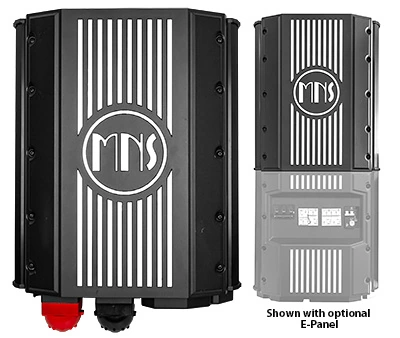
When a customer tells me they want battery backup for a real home—not just a few outlets—I start by asking what kind of power the house actually uses. Many Hawaii homes have both 120-volt loads and 240-volt equipment. That is where I think the stationary MidNite Rosie 7048 RE deserves a close look.
The Rosie 7048 RE is a 48-volt battery inverter/charger that produces 120/240-volt split-phase power from one unit. In plain language, it can serve ordinary 120-volt household circuits while also supporting properly planned 240-volt loads. That is a much better match for a home system than treating every backup project like a small portable-power setup.
Why 120/240 volts changes the conversation
A 120-volt circuit is what you find on many receptacles, lights, refrigerators, and electronics. A 240-volt circuit may serve equipment such as a well pump, workshop tool, water heater, or other larger appliance. The exact loads depend on the home, but the planning question is the same: do you want backup power that fits the way the house is wired?
The Rosie is rated for 7,000 watts of pure-sine AC output. As a simple reference, 7,000 watts divided by 240 volts is about 29 amps. That does not mean every home can run every appliance at once, and it does not replace a proper load calculation. It does give us a useful starting point for discussing what belongs on the backed-up panel and what should wait for more available energy.
MidNite documents the stationary RE model with common AC neutrals for renewable-energy systems such as homes and cabins. That detail matters because the RE model is not simply the mobile Rosie with a different label. MidNite also offers a mobile version with a different neutral arrangement. For a stationary Hawaii installation, I want the model and wiring approach to match the building, the service equipment, and the local electrical design from the beginning.
The Rosie is doing two jobs for you
During an outage or in an off-grid system, the Rosie takes energy from the 48-volt battery bank and creates usable AC power for the backed-up loads. When an accepted utility or generator source is available, it can transfer the loads and charge the battery through its built-in multi-stage charger. MidNite specifies up to 120 amps of battery charging current, subject to the source, settings, battery, and complete system design.
That combination is important. You are not buying only an inverter that waits for the sun. You are choosing a battery-based power center that can support loads, accept an AC source, charge the battery, and work with automatic generator-start controls when the rest of the system is designed for that purpose. The Rosie also has an Auto-Gen Start menu and two auxiliary terminals with configurable functions.
Where the Rosie E-Panel helps
I also like the way the optional Rosie E-Panel organizes the system. It is not required for the inverter to exist, but it adds a purpose-built enclosure for AC input, AC output, battery protection, disconnects, bypass equipment, grounding connections, and optional surge-protection components. That can make a large system easier to understand and service than a collection of separate boxes mounted wherever space was available.
The E-Panel is especially useful when we are building a complete package around a Rosie, charge controller, battery bank, and backed-up-loads panel. It does not eliminate the need for a qualified electrical design. Neutral-to-ground bonding, over-current protection, conductor sizing, and the location of the backed-up panel still have to be handled correctly. MidNite’s E-Panel documentation specifies that only one neutral-to-ground bond should exist in the AC system.
What I would check before recommending it
I would look at your largest starting loads, the battery bank’s continuous and surge capability, whether you need 240-volt output, and whether a generator or utility connection will be part of the plan. I would also confirm that the exact stationary model is the MNROSIE7048RE and use the current manual and nameplate for final settings.
For a Hawaii home, cabin, or off-grid property that needs organized 120/240-volt power rather than a temporary plug-in solution, the Rosie 7048 gives us a solid platform to design around. If you send me your major loads, battery goals, and whether you want generator backup, I can help you decide whether the Rosie is the right center for the system.
See split-phase power in plain language
Samlex America’s educational lesson, 120/240V Split Phase Power Explained, gives a general explanation of how 120-volt and 240-volt power relate in an off-grid system. It is not a review of the Rosie, but it is a useful way to understand why a split-phase inverter can fit a home-style electrical system better than a simple 120-volt unit.